PoJK activist decries lack of press freedom in Pakistan-occupied areas
Synopsis
PoJK activist Amjad Ayub Mirza highlighted the lack of media freedom in PoGB and PoJK, stating that voices are overlooked and information is controlled by Pakistan's PID and ISPR, leading to the suppression of dissenting views on Jammu and Kashmir.
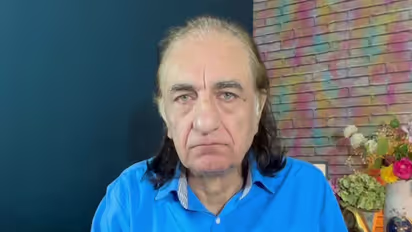
PoJK activist Amjad Ayub Mirza, while marking World Press Freedom Day, highlighted the situation of media freedom in Pakistan-occupied regions, Pakistan-occupied Gilgit-Baltistan (PoGB) and Pakistan-occupied Jammu and Kashmir (PoJK), calling attention to what he described as the ongoing struggle of people living there. In his message, Mirza said that the voices and concerns of people in these regions often remain overlooked, stressing that they are deprived not only of access to genuine and independent information but also of diverse viewpoints in local media.
He alleged that opinion pages and editorial spaces do not accommodate perspectives that question the historical and political developments related to Jammu and Kashmir.
Media Landscape Controlled by Pakistani Authorities
Mirza further claimed that the media landscape in these areas is tightly controlled by Pakistan's Press and Information Department (PID), a federal body based in Islamabad, which he said operates under the influence of the Inter-Services Public Relations (ISPR), the military's media wing. According to him, this control results in the publication of content that largely reflects pro-Pakistan narratives, while alternative or dissenting voices are excluded.
Indirect Censorship and Financial Pressure
He also raised concerns about what he termed as indirect censorship, stating that the dependence of print media on government advertisements creates pressure to conform. Mirza noted that the fear of losing advertising revenue, a primary source of income for newspapers in these regions, leads to self-censorship among media outlets.
Dominance of Print Media
Pointing out the limited presence of electronic media, he said that the absence of local television channels makes print media the dominant source of information. However, he alleged that this dominance is being used as a tool to shape narratives and suppress counter-arguments, particularly on issues related to PoJK.
Mirza called for greater attention to the state of press freedom in these regions, urging the international community and media watchdogs to take note of the challenges faced by journalists and residents in accessing unbiased and independent information. (ANI)