PM Modi at SCO Summit: 13 outcomes, English as official language
Synopsis
PM Modi's participation in the 26th SCO Summit in Bishkek concluded with 13 key outcomes, including the Bishkek Declaration, adopting English as an official SCO language, and establishing a new Universal Centre for Countering Security Threats.
Key Outcomes of the 26th SCO Summit
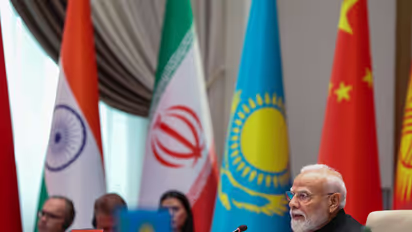
Prime Minister Narendra Modi's participation in the 26th Shanghai Cooperation Organisation (SCO) Summit in Bishkek, Kyrgyzstan, concluded with 13 key outcomes, including the adoption of the historic Bishkek Declaration alongside four MoUs and over 20 decisions, agreeing to adopt English as an official SCO language and establish a new Universal Centre for Countering Security Threats.
According to the Ministry of External Affairs, these outcomes provide India a strategic platform to articulate its positions on regional security, development, and connectivity while strengthening its engagement across Central Asia and the wider Eurasian region. The summit adopted the core Bishkek Declaration on the 25th Anniversary of the SCO, consolidating member states' positions on regional security and development.
In a fundamental institutional move, leaders approved the Protocol on Amendments and Additions to the Charter of the Shanghai Cooperation Organisation of June 7, 2002. The MEA noted that this enables India to actively participate in shaping the SCO's evolving institutional framework, ensures India's interests are appropriately reflected in the organization's future functioning, and supports the formal inclusion of English within the SCO framework.
Regional Counter-Terrorism and Security
On regional counter-terrorism and security, member states approved the Regulations on the Universal Centre for Countering Challenges and Threats to the Security of SCO Member States. This decision enhances joint cooperation against terrorism, extremism, organised crime, and other transnational threats while strengthening security information exchange.
Combating Narcotics and Organised Crime
To target law enforcement, drug trafficking, and organised crime, the summit finalised four separate outcomes. Leaders approved the Regulations on the Executive Committee of the SCO Anti-Narcotics Centre, supporting India's efforts against cross-border narcotics trafficking and narco-terrorism while facilitating inter-agency coordination.
Member states established the Programme of Cooperation among SCO Member States in Combating Drug Addiction until 2030, complementing India's drug-demand reduction efforts and enabling the exchange of best practices in prevention, treatment, and rehabilitation.
The summit also adopted the Programme of SCO Member States on Coordination of Measures to Combat the Proliferation of Synthetic Drugs and their Precursors for the period up to 2030 to address synthetic drug diversion and improve operational coordination among enforcement agencies. Additionally, governments signed a Protocol on amendments and additions to the Agreement on cooperation in combating crime of June 11, 2010, reinforcing law enforcement coordination against organised and cross-border crime.
Cooperation on Energy and Climate
On energy and climate, SCO member states signed three major agreements. A statement on developing cooperation in the field of energy conservation and energy efficiency was endorsed to support India's energy-security objectives and enable technology exchanges.
Leaders adopted a Statement on the Development of Cooperation in the Field of Energy Systems to promote the development, modernisation, and resilience of energy systems across member countries.
Governments further concluded a Memorandum on cooperation in combating climate change, providing an additional platform for climate adaptation, technology cooperation, and climate-resilient development aligned with India's development priorities.
Emergency Response and Disaster Management
Addressing emergency response, member states signed a Statement on providing assistance to States affected by emergencies. The MEA highlighted that this agreement complements India's capabilities in disaster management and Humanitarian Assistance and Disaster Relief, enables capacity-building, and promotes cooperation on disaster-resilient infrastructure.
Technology, Media, and AI Cooperation
In technology, media outreach, and innovation, member agencies signed a Memorandum on cooperation in the field of information to promote institutional exchanges and facilitate wider dissemination of India's perspectives within the regional media space.
Simultaneously, governments signed a Memorandum on cooperation in the field of artificial intelligence, allowing India to share its digital and AI experience, promote the responsible and inclusive use of AI, and expand technology partnerships across the grouping.
PM Modi's Address at the Summit
The adoption of these outcomes followed an address by Prime Minister Narendra Modi at the summit in Bishkek. According to MEA, Prime Minister Modi emphasised that the 25th anniversary provides an opportune moment to establish a roadmap for the next 25 years.
Vision for SCO's Future
Focusing on joint progress, he stated, "In the last Summit, India had shared its vision of Security, Connectivity and Opportunity, and now the group must work to realise concrete outcomes in these three pillars of joint work."
On Global Conflicts and Terrorism
Highlighting ongoing global conflicts, the Prime Minister reiterated India's diplomatic stance, stating that "conflicts cannot be resolved on the battlefield and dialogue and diplomacy are the only way forward." Calling terrorism a grave threat to humanity, he urged member nations to take committed action to dismantle the terror ecosystem and "stressed that there should be no double standards whatsoever in fight against terrorism."
Regional Connectivity and Afghanistan
He further noted that security across Eurasia remains closely linked to peace and stability in Afghanistan, pointing to India's ongoing humanitarian and development assistance to the country. On regional infrastructure and trade, the Prime Minister advocated for strong, trusted connectivity initiatives that link markets while cautioning that all such efforts "should respect sovereignty and territorial integrity of nations."
SCO Civilisation Dialogue and Conclusion
Appreciating the summit's focus on youth engagement, he announced that "India would be delighted to host the first edition of the SCO Civilisation Dialogue Forum, later this year," describing it as India's flagship initiative aimed at forging civilisational exchanges among member states.
The MEA noted that Prime Minister Modi thanked Kyrgyz President Sadyr Zhaparov for his hospitality and the successful organisation of the summit, reaffirming India's commitment to working with the SCO family for shared regional progress and prosperity.
The SCO summit was held from August 31 to September 1, 2026 in Bishkek, Kyrgyzstan. The summit was chaired by Kyrgyz President Sadyr Japarov under the theme "25 Years of the SCO: Together for Sustainable Peace, Development and Prosperity." (ANI)
(Except for the headline, this story has not been edited by Asianet Newsable English staff and is published from a syndicated feed.)