‘'Not One Drop Will Be Taken’': Pakistan PM Shehbaz Sharif Warns India Over Indus Waters Treaty Suspension
Synopsis
Pakistan PM Shehbaz Sharif warned India against suspending the Indus Waters Treaty, vowing it cannot take “even one drop” of Pakistan’s water. Tensions rose after India put the treaty in abeyance following the Pahalgam attack.
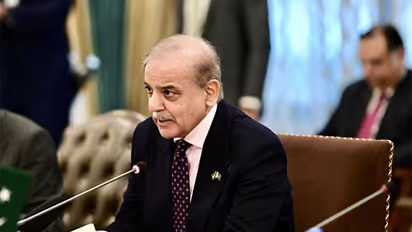
Islamabad: Prime Minister Shehbaz Sharif on Tuesday issued a sharp warning to India, declaring that Pakistan would not permit its neighbour to take “even one drop” of water from its rightful share under the Indus Waters Treaty (IWT) of 1960. His remarks come amid escalating tensions between the two nuclear-armed nations after New Delhi suspended the decades-old agreement, which governs the sharing of the Indus River system. The decision, announced on April 23 , a day after the deadly April 22 Pahalgam terror attack that killed 26 people, has triggered strong political, military, and diplomatic responses in Islamabad, with officials calling the move a direct threat to Pakistan’s water security.
Sharif’s Stern Warning
Addressing an event in Islamabad, Sharif accused India of threatening Pakistan’s water rights and issued a blunt warning:
“If you threaten to hold our water, keep in mind that you cannot snatch even one drop of Pakistan’s share. If you try, you will be taught a lesson that will leave you holding your ears.”
He said any move to block or divert river flows would be considered an act of aggression.
Political And Military Reactions
Former foreign minister Bilawal Bhutto-Zardari also denounced the suspension of the treaty, calling it “an attack on the Indus Valley Civilisation” and warning that Pakistan would not hesitate to respond if provoked.
Army Chief General Asim Munir, speaking to Pakistani expatriates in Tampa, Florida, warned that Islamabad would destroy any dam India builds to cut off the water supply.
“The Indus River is not India’s family property. We have no shortage of resources to undo Indian designs,” he was quoted as saying by Dawn.
Diplomatic Position
Despite the heated rhetoric, Pakistan’s Foreign Office said the country remained committed to the “full implementation” of the IWT and urged India to immediately restore its normal functioning.
Backdrop Of Military Escalation
Tensions over water sharing have been heightened by recent military exchanges. On May 7, India launched Operation Sindoor, targeting what it described as terror infrastructure in Pakistan and Pakistan-occupied Kashmir in retaliation for the Pahalgam attack.
After four days of drone and missile strikes across the border, both sides reached an understanding on May 10 to halt hostilities.