Pakistan is US messenger to Iran in West Asia conflict: Ex-envoy
Synopsis
Former Indian envoy Ajay Bisaria says Pakistan is acting as a US messenger to Iran in the West Asia conflict. He calls it a US manoeuvre, citing historical examples and Pakistan's 'controllable' status and strategic position for the role.
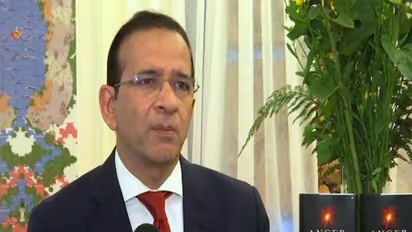
With Pakistan pushing for a mediation role in the West Asia conflict which has entered the second month, former Indian High Commissioner to Pakistan Ajay Bisaria has said that Islamabad has been chosen as a messenger for yet another US manoeuvre to keep channels open with Iran and this would not be the first Pakistani role in transmitting secret messages to a US adversary.
In an interview with ANI, Ajay Bisaria said the month-long war in West Asia is at a stage where hostilities persist while both sides have presented each other public wish lists of maximalist demands. "No 'peace talks' can be said to be underway but the US seeks dependable messengers. Having been attacked twice mid-talks in the past year, the Iranians perceive the US 15-point demand as an unacceptable 'surrender plan', or perhaps more accurately, another ploy to string them along until April 6, after which a joint US-Israel 'final blow' is anticipated, given that US paratroopers and marines would be positioned in the region," he said.
Pakistan's History as a US Messenger
Bisaria, who was High Commissioner to Pakistan from December 2017 to February 2020, said that Oman, disillusioned with the US's diplomatic feint with Iran in February, has clearly opted out. "So Pakistan has been chosen the messenger for yet another US manoeuvre to keep channels open with Iran. This would not be the first Pakistani role in transmitting secret messages to a US adversary. In 1971, it did so with China (when Kissinger feigned a stomach ache to stage a visit to Beijing from Islamabad on a Pakistani plane). In return, Pakistan got a free pass for a genocide in its East," he said.
Why Pakistan is a 'Controllable' Messenger
Bisaria said the US requires a messenger who is connected to the adversary's power structure and can be controlled. "In 1981, Pakistan, along with Algeria, assisted the US in the hostage crisis. The US requires a credible messenger who is not only connected to the adversary's power structure but is also controllable. Ideally, this would be an autocracy capable of maintaining operational secrecy. And also one that can pull in some regional stakeholders. Pakistan fits this bill. It is a US 'non-NATO ally' and is under US CENTCOM jurisdiction, just as Iran is," he said.
"Additionally, it is a contiguous neighbour of Iran, where the Iranians could potentially show up for talks with the US or its territory could be utilised for covert air or ground operations if the situation escalates. Pakistan also plays a convening role for the Gulf Arab states and brought together Saudi Arabia, Turkey, and Egypt for a quadrilateral meet in Islamabad, where none of the belligerents- Iran, US or Israel - were represented," he added.
Bisaria noted that Pakistan's Foreign Minister is now trying to involve another extra-regional player China in the process. "However, it would find it hard to keep all its external benefactors-the US, China and Saudi Arabia- simultaneously pleased with its role," he said.
India's Contrasting Role
Bisaria said India has good relations with all sides of the conflict but it does not have to play to a role that Pakistan is pitching for. "While India has peace-making potential in this conflict due to its equities and connections on both sides, it cannot be controlled by the US...India needs to play a more significant peace-promoting role in the conflict, but not in the manner of Pakistan and not at the current stage," Bisaria said.
Iran Downplays Negotiation Claims
As the security situation develops in the region, Iran has debunked Trump's claims of the country asking for a ceasefire to the US, Press TV reported on Wednesday. Meanwhile, Iranian Foreign Minister Abbas Araghchi on Tuesday in an interview to Al Jazeera, confirmed that he held a direct conversation with top US-envoy Steve Witkoff amid the ongoing war, but downplayed talks of negotiations-- with no mention of Pakistan in the equation.
"I receive messages from Witkoff directly, as before, and this does not mean that we are in negotiations... There is no truth to the claim of negotiations with any party in Iran. All messages are conveyed through the Foreign Ministry or received by it, and there are communications between security agencies," Araghchi told Al Jazeera.
The conflict between Israel-US and Iran began on February 28 and has escalated tensions in West Asia apart from causing disruptions in global energy supply chains. (ANI)
(Except for the headline, this story has not been edited by Asianet Newsable English staff and is published from a syndicated feed.)