Nepal floods: 359 dead, 910 missing; PM Shah vows full response
Synopsis
Nepal PM Balen Shah said state machinery is at 'full capacity' to deal with flash floods that killed 359 and left 910 missing. Over 13,000 security personnel are deployed for search, rescue and relief operations across affected districts.
Nepal Prime Minister Balen Shah on Thursday said the country's state machinery has been mobilised at "full capacity" to deal with the devastating flash floods that have killed 359 people and left 910 missing or out of contact, as search, rescue and relief operations continue across several affected districts.
Shah made the remarks in a statement on Facebook after visiting the flood-hit Nuwakot earlier today, where he personally assessed the situation and spoke with affected residents, local representatives, security personnel, health workers and others involved in rescue and relief operations.
Rescue and Relief Operations
"The situation is still challenging. All state mechanisms are operating at full capacity. Right now, our first priority is to save the lives of each and every citizen, search and rescue of the missing, treat the injured and provide immediate relief to the affected families," Shah said in his statement.
The Prime Minister said 13,295 security personnel from the Nepal Army, Armed Police Force and Nepal Police have been deployed for search and rescue operations. The deployment comprises 7,250 Nepal Police personnel, 4,200 Nepal Army personnel and 1,845 Armed Police Force personnel.
Shah said the operations are being continuously coordinated through the Nepal Army's Joint Operation Committee, the Quick Action Team of the National Disaster Risk Reduction and Management Authority (NDRRMA) and the Rapid Action Team of the Prime Minister's Office.
Rescue operations are being conducted by both air and land, with 573 people rescued through 69 air flights on Thursday, according to Shah. Additional helicopters have been kept on standby, while private helicopters have also been mobilised for rescue and relief operations under the government's command and coordination system.
"Priority has been given to the sick, pregnant and lactating women, children, senior citizens and people with disabilities in air rescue," Shah said.
The government is also relocating stranded citizens and security personnel from affected areas, including Rasuwa, Nuwakot and Dhading, to safer locations. Temporary accommodation has been arranged in schools and public or community buildings for around 3,500 people, he said.
Shah said NPR 10 million each has been mobilised for Rasuwa and Nuwakot and NPR 5 million for Dhading for immediate relief to affected residents. Ten trucks carrying relief materials, including noodles, biscuits, sleeping bags, mattresses and blankets, have been sent to the affected areas. Additional food and non-food items are being transported by helicopter.
Temporary relief camps have also been established to provide food, drinking water and essential services. The Nepal Red Cross, Nepal Scout, Lions Club and other voluntary organisations have been mobilised for relief and rescue, with relief materials for around 30,000 people sent to affected areas by the Red Cross, Prime Minister said.
Healthcare System on High Alert
The Health Emergency Operation Center (HEOC) has been activated, while Bir Hospital, Trauma Center, Teaching Hospital, Civil Hospital, Patan Hospital and Police Hospital have been placed on standby.
Shah said 100 emergency beds each have been prepared at Bir Hospital and the Trauma Center and 60 at Patan Hospital. Medical teams, medicines, ambulances and blood transfusion services have been mobilised as required, while free treatment has been assured for affected and injured citizens.
Restoration of Essential Services
Restoration of telecommunications has been accorded emergency priority, with at least 70 towers/sites closed, including 38 Nepal Telecom and 32 Ncell sites. Technical teams, generators and batteries are being deployed to restore connectivity in affected areas.
The Prime Minister said Nepal Telecom has provided affected citizens with 2 GB of data, 50 SMS and free voice calls daily, while Ncell has also provided free voice, data and SMS facilities.
The government has simultaneously prioritised the restoration of roads, bridges, drinking water, electricity and telecommunications infrastructure. Drone surveys and on-site assessments are being conducted to identify stranded citizens, blocked roads and access conditions and to make rescue and relief operations more targeted, Shah said.
Monitoring Ongoing Risks
Amid concerns over further risks, authorities are continuously monitoring the Bhotekoshi and Trishuli rivers, possible landslides and other hazards. Shah said residents in risky riverbank areas of Rasuwa, Nuwakot, Dhading, Gorkha and Chitwan have been urged to move to safer locations.
"Keeping in mind the potential additional risks, citizens in the riverbank areas have been urged to adopt high alertness," he said.
Earlier in the day, China warned of Nepal of risk of another major flood in the Bhotekoshi River system after a lake formed upstream following an obstruction in the upper course of the river system in Lhende River, with the NDRRMA urging people and all concerned agencies in downstream areas to "exercise necessary caution" and remain highly vigilant.
Fuel and Logistics Management
The Nepalese government has also taken measures to prevent fuel shortages in affected areas. Shah said stocks in Nuwakot include 23,000 litres of diesel and 6,000 litres of petrol, while an additional 15,000 litres each of diesel and petrol have been sent.
Casualty and Missing Persons Report
According to the latest NDRRMA update issued up to 6:20 PM (local time) on Thursday, 359 bodies have been recovered from eight districts. The highest number of bodies has been recovered in Chitwan (132), followed by Nawalparasi East (82), Dhading (33), Gorkha (30), Nuwakot (28), Tanahun (22), Rasuwa (17) and Nawalparasi West (15). The Gorkha figure includes various human body parts.
Of the 910 people missing or out of contact, the list includes 28 Nepal Police personnel, 44 Nepal Army personnel, 13 Armed Police Force personnel, 15 Customs Office personnel and four Immigration Office personnel. Rasuwa accounts for 161 missing or out-of-contact people, based on information from the District Emergency Operation Centre, while one person is missing in Nuwakot.
The disaster has also affected foreign nationals, with 517 foreign citizens reported missing or out of contact. A further 127 Nepali citizens living abroad who were visiting Nepal have also been listed.
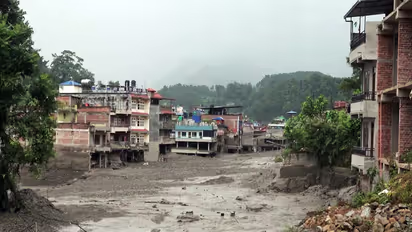
This comes after a major flash flood struck Nepal's Rasuwa district on Wednesday morning, sending a powerful surge of water, sediment and boulders through the Bhotekoshi and Trishuli river systems, raising concerns over further downstream impacts.
Mobilising National and International Support
Shah said Nepal is mobilising national and international support for relief and rehabilitation. "Relief materials have been received from India, while necessary support and coordination is being carried out with international partners including the US, EU, WHO, IFRC," he said.
Support from the private sector and civil society is also being integrated into the response.
The Prime Minister said the government remains focused on saving lives, locating and rescuing missing people, treating the injured, providing immediate relief and safe accommodation, and restoring damaged essential infrastructure. "There will be no shortage of resources and means required for rescue and relief work. We are still at work. The government stands with the affected citizens in this hour of crisis. All state mechanisms will remain on the ground until the rescue and relief work is completed," Shah added. (ANI)
(Except for the headline, this story has not been edited by Asianetnews Editorial staff and is published from a syndicated feed.)