Nepal flood: Rescuers near 6 trapped in Chilime hydropower tunnel
Synopsis
Rescue teams are close to reaching 6 workers trapped in Nepal's Chilime tunnel after floods. The Indo-Nepali effort faces challenges like a negative slope and water, with 50m left to clear. Hope remains for the workers' survival.
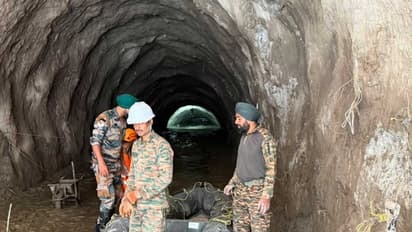
Nearly three weeks after devastating floods swept through Nepal on August 26, rescue teams working round the clock at the Chilime hydropower tunnel are closer than ever to reaching six people believed to be trapped inside. But the final stretch of the operation remains the most challenging, with rescuers battling water inside the tunnel and a negative slope that is making it difficult to clear debris and pump out water.
Final 50 Metres Prove Most Challenging
The Indian and Nepali teams have so far cleared about 150 metres of the tunnel and are now around 50 metres from the powerhouse, where the trapped workers are believed to be. Nepali MP and hydromechanical engineer Sagar Dhakal, who has been involved in the rescue operation for the past 18 days, said the teams were working through the night and were hopeful of making further progress on Tuesday, provided they did not encounter another major obstruction. “With the machines, we have raised roughly 100 metres plus, and then with the people, we have reached 150 metres plus in the tunnel. The tunnel itself is roughly 220 metres, so we are still yet to reach the 50 metres plus,” Dhakal told ANI in an exclusive interview near the tunnel site.
The immediate challenge is a water pond inside a narrow “rat hole”, where Nepali Army rescuers have been carrying out manual excavation. The water level has made it difficult for them to move further. The rescue teams are now working to bring in a mini-pump capable of pumping the water out. If the water can be removed and the machinery continues to work without encountering large boulders or other obstructions, Dhakal said the teams could make significant progress. “Whenever we say hopefully, there are many challenges on the way. We don't know what will come ahead,” he said, adding that large boulders could still delay the operation by several days.
Engineering Hurdles and Safety Concerns
The Chilime tunnel presents a different set of challenges from another tunnel, where Dhakal had earlier worked. Unlike that site, the Chilime tunnel has a negative slope of around 6.5 per cent over the first 100 metres, meaning water and debris do not move out easily.
The tunnel is also located next to a large river, with limited space for helicopters to land. The rescuers therefore first had to construct a road to the tunnel face and a roadway across the river, creating escape routes for workers in case of another flood. “The biggest challenge we have had till now was that there was no escape route. In case there is a flood, there is no way you can run away,” Dhakal said.
The scale of the debris has added to the difficulty. Rescuers are working in confined spaces where muck can rise above their knees, while large boulders can stop machinery from advancing.
Hope for Trapped Workers
Despite the difficulties, Dhakal said the teams remained hopeful that the six people believed to be trapped inside are alive. There has been no communication with them so far. “We believe there is a kitchen and the water and everything. And hopefully people are alive. That is what we are praying,” he said.
Joint Indo-Nepali Effort
The operation has also brought Indian and Nepali teams together, with Dhakal describing the cooperation between the two sides as a joint effort. “We all are working together hand in hand. We all are friends now. Whether the Indian Army or Nepali Army or I as MP engineers, we all are friends. We are all working for the same mission,” he said.
He specifically mentioned an Indian Army officer, Parikshit, for his assistance with the tunnel operation, saying he had previous experience in tunnel operations and was working with a larger team. Dhakal said the Indian team had also brought new technology and ideas to the operation.
Among the assistance was a chemical that helps separate mud from water, allowing rescuers to work on the mud more effectively. At the same time, he said, the Nepali side had shared its experience with the Indian team, including the use of water-jetting machines. “So it’s a two-way thing,” Dhakal said. “It has been very helpful.”
Lessons in Disaster Preparedness
Dhakal said the disaster should also prompt a review of hydropower tunnel designs and emergency preparedness. One of the key lessons, he said, was the need for a safe escape route from powerhouses and tunnels to higher ground in the event of a flood.
He also said the location and design of hydropower projects need to account for natural hazards, while tunnel designs should consider the possibility of rescue operations and, where possible, positive slopes that can help water drain out. “We are really missing a critical part. There is not a safe exit way,” he said, arguing that future projects should incorporate emergency escape routes leading towards the mountains.
He said Nepal, India and other countries sharing the Himalayan river systems also needed to work together on disaster preparedness, as natural hazards in one part of the region could have consequences downstream. (ANI)
(Except for the headline, this story has not been edited by Asianet Newsable English staff and is published from a syndicated feed.)