Nepal Election 2026: Interim PM Karki casts vote after Gen Z movement
Synopsis
Nepal's Interim PM Sushila Karki cast her vote as the country's 2026 general election began. The snap polls, triggered by the 'Gen Z movement', will see 18.9M voters elect a new government after a six-month interim administration.
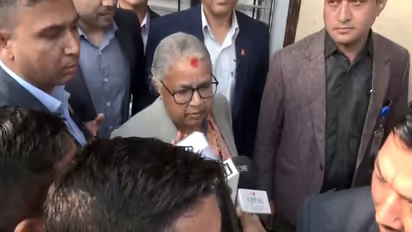
Nepal's interim Prime Minister Sushila Karki cast her vote today morning at the Dhapasi polling centre in Kathmandu as the country's 2026 general election commenced on Thursday. The interim Prime Minister's participation marks a pivotal moment in the transition toward a newly elected government following months of political turbulence, with the "Genz movement" leading to the resignation of multiple political leaders, including former PM KP Sharma Oli.
Speaking to ANI after exercising her franchise, Karki reflected on the conclusion of her administrative mandate, stating, "My duty is completed." According to a report by The Kathmandu Post, these high-stakes snap polls were necessitated by the historic "Gen Z movement" in September. The uprising resulted in the removal of the KP Sharma Oli-led coalition and the subsequent dissolution of the House of Representatives, leading to Karki's appointment as executive head on 12 September.
Election Preparations and Voter Details
The Election Commission, backed by the Karki-led administration, confirmed that all arrangements are finalised to return the country to an elected government after a six-month interim period. Acting chief election commissioner Ram Prasad Bhandari stated, "All the arrangements for free, fair, transparent and peaceful elections are in place," while he further "urged everyone to exercise their franchise without fear" during the 10-hour voting window.
The Kathmandu Post highlighted that 18,903,689 registered voters will determine the fate of 6,541 candidates vying for 275 seats in the House of Representatives. This electorate sees an increase of over 915,000 voters since 2022, with a significant 52 per cent belonging to the 18-40 youth demographic.
Candidate and System Breakdown
Of the total candidates, 3,406 are contesting under the first-past-the-post (FPTP) system, while the remainder seek office through proportional representation. Within the FPTP system, 65 parties have fielded 2,263 candidates for 165 seats, alongside 1,143 independent contenders. However, gender demographics remain heavily skewed, with 3,017 male and 388 female candidates, and only one individual representing the sexual and gender minority community. The Kathmandu Post also noted an age gap in the candidate pool; 1,925 candidates are aged between 41 and 60, while a mere 201 are aged 30 or younger.
Regarding the 110 proportional seats, 63 parties have submitted a list of 3,135 candidates, split equally between males and females. To qualify for these seats, a party must secure at least three per cent of the proportional vote and win at least one FPTP seat to gain national party status.
Security and Logistics
341,113 security personnel have been mobilised across 10,963 polling stations to maintain order, including 149,000 temporary "election police." A Security Council meeting chaired by Prime Minister Karki on Wednesday concluded that the current environment would likely be more transparent than previous cycles.
"No force can disrupt the election," Bhandari asserted, expressing confidence that high engagement from young voters would boost turnout and reduce invalid ballots. While voter participation hit a low of 61.4 per cent in 2022, the historical average since 2006 stands at 69.4 per cent.
To ensure a swift conclusion, authorities plan to use helicopters to retrieve ballot boxes from difficult hilly terrain. Officials expect to "publish the results of the first-past-the-post vote within 24 hours after vote counting begins."
(Except for the headline, this story has not been edited by Asianet Newsable English staff and is published from a syndicated feed.)