Modi, Albanese Summit Ushers in 'New Phase' of India-Australia Ties
Synopsis
PM Modi and Australian PM Albanese concluded their annual summit, deepening their strategic partnership. Key outcomes include a new defence and security declaration, progress on trade deals, and cooperation on energy, critical tech, and a free Indo-Pacific.
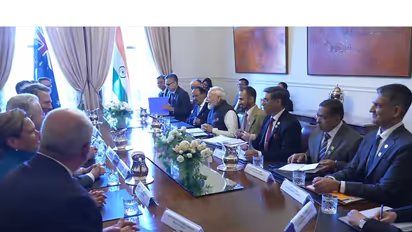
Prime Minister Narendra Modi and Australian Prime Minister Anthony Albanese on Thursday concluded the Third Australia-India Annual Summit in Melbourne, unveiling a wide-ranging agenda to deepen cooperation across defence, security, trade, energy, critical technologies, education and global governance while reaffirming their shared commitment to a "free, open, rules-based, peaceful and prosperous Indo-Pacific."
Held from July 8-10, the summit marked what both sides described as a new phase in the India-Australia Comprehensive Strategic Partnership (CSP). The joint statement noted that the meeting took place against the backdrop of an "obvious strong relationship between Prime Minister Modi and Prime Minister Albanese that has been there now for a few years," with that personal rapport serving as the engine for a "strong strategic partnership."
Defence and Security Cooperation
The leaders reaffirmed their commitment to expanding the CSP to respond to "emerging challenges in a rapidly evolving global environment." They also announced the Joint Declaration on Defence and Security Cooperation, describing it as a "step-change in the depth and ambition of the bilateral defence and security relationship." The declaration elevates defence cooperation as a "cornerstone of the partnership" and establishes an Annual Defence Ministers' Dialogue to strengthen strategic consultations.
Maritime Security
Maritime security featured prominently during the summit, with the launch of the 'India-Australia Maritime Security Collaboration Roadmap'. Stressing that "effective maritime cooperation is essential to regional security," the leaders announced a Memorandum of Understanding between Australia's Maritime Border Command and the Indian Coast Guard, committed to enhancing interoperability, continuing the "General Rawat India-Australia Young Officers' Exchange Program," hosting an Indian military instructor at the Australian Defence College by 2028-29, and exploring a bilateral defence innovation framework linking industry and research institutions.
Economic and Industrial Partnership
On the economic front, the leaders welcomed the "continued growth in two-way trade under the India-Australia Economic Cooperation and Trade Agreement (ECTA)" and committed to "progressing an ambitious, balanced and mutually beneficial Comprehensive Economic Cooperation Agreement (CECA)" to "unlock the full potential of the economic relationship." Highlighting industrial cooperation, they recognised the complementarities between India's "Make in India" initiative and Australia's "Future Made in Australia" policy. The leaders also underlined that "transparent, secure and resilient supply chains are central to our economic security," particularly in critical minerals and advanced manufacturing.
Energy Security and Nuclear Cooperation
Energy security emerged as a key outcome of the summit. The leaders highlighted the opportunity to "strengthen uranium out of Australia into India to meet its huge ambitions of 1,000 gigawatts by 2047." They welcomed the finalisation of the Administrative Arrangement under the Australia-India Nuclear Cooperation Agreement, saying it "will enable long-term Australian uranium exports to India for exclusively peaceful purposes and under IAEA safeguards." They also reaffirmed support for the India-Australia Renewable Energy Partnership and initiatives such as the Rooftop Solar Academy while reiterating that the Paris Agreement should reflect "equity and the principle of common but differentiated responsibilities."
Technology, Supply Chains and Space
The summit also witnessed the launch of the Australia-India Partnership on Cyber, Critical Technologies and Supply Chains (PACTS), aimed at "raising the ambition of our relationship on critical technologies, supply chain diversification, cyber security, digital resilience, and defence research." The leaders also welcomed continued cooperation in the space sector, including Australian support for India's Gaganyaan Human Space Flight Programme through a temporary space tracking terminal on the Cocos (Keeling) Islands.
People-to-People and Cultural Ties
People-to-people ties remained a major focus, with both leaders describing "people-to-people links" as central to the bilateral relationship. Prime Minister Albanese said, "Indian students in Australia are welcomed and are valued members of Australian classrooms, campuses and communities." The leaders also welcomed the establishment of campuses by Flinders University in Bengaluru and Victoria University in Gurugram, as well as a National Centre of Excellence for Skilling in Mining in Odisha.
They further highlighted sport as a "vital component of our bilateral relationship," looking ahead to the 2030 Commonwealth Games in Ahmedabad and the 2032 Olympic Games in Brisbane. The leaders also committed to the "protection and preservation of cultural heritage," including the voluntary and unconditional repatriation of First Nations ancestral remains from India and Telugu remains from Australia.
Global Governance and Multilateralism
On global governance, Australia "reiterated its support for India's candidacy for a permanent seat in a reformed UNSC." Both countries also pledged mutual support for each other's non-permanent membership of the UN Security Council for the 2028-2030 term and stressed that the United Nations should better reflect "contemporary geopolitical realities."
International Security and Regional Issues
Addressing international security, the leaders "unequivocally condemned terrorism and violent extremism conducive to terrorism in all its forms and manifestations," condemned the "horrific attacks perpetrated at Pahalgam and Bondi Beach," and called for action against UN-listed terrorist entities. They also expressed deep concern over tensions in West Asia and the "tragic humanitarian consequences" of the war in Ukraine, urging restraint, diplomacy and adherence to international law. The leaders reaffirmed their support for ASEAN centrality and the implementation of the ASEAN Outlook on the Indo-Pacific.
At the end of the summit, the leaders expressed satisfaction with the progress achieved under the Comprehensive Strategic Partnership and reaffirmed their commitment to a "free, open, rules-based, peaceful and prosperous Indo-Pacific," describing the relationship as a "strong strategic partnership" that has undergone a "step-change" in ambition and scope. (ANI)
(Except for the headline, this story has not been edited by Asianet Newsable English staff and is published from a syndicated feed.)