Mecca Pact Faces Difficult Questions Over Shared Threats, Costs and Strategic Commitments Ahead
Synopsis
A newly signed regional defense arrangement has drawn attention beyond its security promises, with deeper questions emerging about interests, obligations and long-term cohesion.
The recently signed Mecca Joint Defense Agreement between Saudi Arabia, Türkiye and Pakistan has been presented as a major step toward deeper military cooperation, but significant questions remain about how the arrangement would function during an actual conflict.
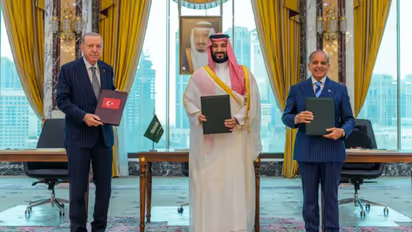
Signed on August 7, 2026, by Türkiye’s Recep Tayyip Erdoğan, Saudi Crown Prince Mohammed bin Salman and Pakistani Prime Minister Shehbaz Sharif, the agreement commits the three countries to collective defense and broader security cooperation. The initiative follows the Saudi-Pakistani Strategic Mutual Defense Agreement concluded in September 2025.
Momentum behind the pact continued on August 31, when foreign ministers, defense ministers and military leaders from the three countries met in Istanbul. The meeting produced plans for a secretariat based in Saudi Arabia, initially led by a Pakistani secretary general, along with expanded cooperation in defense production and military technology.
Yet the central uncertainty remains unresolved: what practical actions would follow if one member came under attack.
According to a Pakistani Foreign Ministry statement, the three governments agreed that an armed attack on one member would be treated as an attack on all. However, publicly available details do not explain which forces would be deployed, who would command them, how decisions would be taken or how quickly a response would occur.
Collective defense arrangements generally require members to share understandings regarding common threats, military responsibilities, financial commitments and escalation risks. Those issues remain largely undefined.
A further challenge stems from competing political ambitions. All three countries promote themselves as influential voices in the Muslim world, but each advances a different vision of leadership.
Türkiye under Erdoğan has increasingly connected its international role to Ottoman history and influence. Saudi Arabia derives its standing from its custodianship of Islam’s holiest sites and its established role in Islamic diplomacy. Pakistan has frequently highlighted its military strength and strategic capabilities as a source of influence across the Muslim world.

Regional priorities and military realities complicate cooperation
Differences in foreign policy have also produced disagreements in the past. During the 2017 Qatar blockade, Türkiye supported Doha with troops and supplies despite Saudi pressure. Pakistan likewise declined Saudi requests for military participation in Yemen in 2015, with parliament voting to remain neutral.
More recently, despite bilateral and trilateral defense arrangements, neither Pakistan nor Türkiye has become directly involved in Saudi Arabia’s current security challenges linked to attacks on energy infrastructure and regional instability.
Military interoperability presents another obstacle. Türkiye operates within NATO structures and maintains a significant domestic defense industry. Pakistan depends heavily on Chinese military equipment, while Saudi Arabia relies largely on Western suppliers.
According to SIPRI data cited in the analysis, China accounted for 80 percent of Pakistan’s major arms imports between 2021 and 2025, while the United States supplied 77 percent of Saudi Arabia’s imports during the same period.
Any future joint military operation would require intelligence sharing and coordination among systems supplied by competing powers. Such cooperation could raise concerns for suppliers seeking to protect sensitive technologies and operational information.
Türkiye’s own experience illustrates the issue. In 2019, the United States removed Ankara from the F-35 program following its acquisition of Russia’s S-400 air defense system, citing security concerns related to technology exposure.
NATO membership introduces another layer of complexity. While Türkiye is bound by alliance commitments, those obligations do not automatically extend to Pakistan or Saudi Arabia through a separate agreement.
Economic questions also remain unanswered. Saudi Arabia possesses substantial financial resources, Türkiye contributes industrial capability and Pakistan remains dependent on IMF support. The agreement outlines institutional coordination but does not specify how costs would be distributed during a conflict or whether financial contributions would influence decision-making authority.
The strategic landscape is equally complicated. Saudi Arabia faces security concerns linked to Iran and the Houthis, while both Pakistan and Türkiye maintain relations with Tehran. Meanwhile, the three members hold differing positions regarding Israel and other regional priorities.
Pakistan’s rivalry with India presents another potential dilemma. Saudi Arabia maintains significant economic relations with New Delhi, raising questions about how competing partnerships would be managed during a crisis.
Ultimately, the pact establishes an ambitious collective-defense principle. Whether that principle translates into military action may depend less on treaty language and more on whether the three nations can reconcile their differing strategic interests when confronted by a real-world security challenge.