Lavrov Affirms Strategic Ties With India China And Iran Cooperation
Synopsis
Russian Foreign Minister Sergey Lavrov emphasized Moscow's strong partnerships with India, China, and Iran, asserting that the global transition to a multipolar order is inevitable despite changing international dynamics and Western influence.
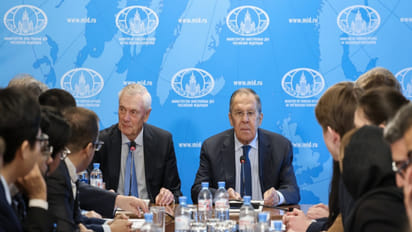
Moscow [Russia], November 27 (ANI): Russian Foreign Minister Sergey Lavrov has highlighted Moscow's strategic partnerships with India, China and Iran, underlining Russia's expanding diplomatic engagement beyond Western countries amid a transition towards a multipolar world order. Speaking at a meeting with participants of the Alexander Gorchakov Public Diplomacy Fund's Dialogue for the Future programme in Moscow on Thursday, Lavrov said Russia continued to maintain strong partnerships with major countries and regional groupings despite the deterioration of its relations with Western nations.
Highlighting India's importance in Moscow's foreign policy, Lavrov described the bilateral relationship as a "privileged strategic partnership", while also pointing to Russia's close cooperation with China and its advanced strategic partnership with Iran. "Our relations with India are officially described as a privileged strategic partnership. We also enjoy an especially advanced strategic partnership with the Islamic Republic of Iran, formalised in a treaty signed a year and a half ago," Lavrov said.
Referring to Moscow's engagement with Beijing, the Russian Foreign Minister said the partnership with China had once again demonstrated its effectiveness at the recently concluded Asia-Pacific Economic Cooperation (APEC) summit in Shenzhen, particularly in the context of the first-ever trilateral summit involving Russia, China and the United States. "Then, of course, there is our partnership with the People's Republic of China, which once again demonstrated its effectiveness at the APEC summit in Shenzhen, not least through the first-ever trilateral summit involving Russia, China and the United States," he said.
Lavrov also highlighted Russia's broader network of international partnerships, including the Collective Security Treaty Organisation (CSTO), the Commonwealth of Independent States (CIS), the Eurasian Economic Union (EAEU), the Shanghai Cooperation Organisation (SCO) and BRICS. "We have no shortage of partners with whom to work: there are the CSTO, the CIS, the EAEU, the SCO and, of course, BRICS, a broad-based association of truly global reach," he said.
The remarks come amid continued high-level engagement between Moscow and New Delhi. In September, Prime Minister Narendra Modi met Russian President Vladimir Putin on the sidelines of the 18th BRICS Summit in the national capital, following an earlier meeting between the two leaders at the Shanghai Cooperation Organisation (SCO) Summit in Bishkek in August. According to the Prime Minister's Office, the leaders reviewed cooperation in political, economic, defence, energy, space, skill mobility and people-to-people domains. They also discussed regional and global developments, including conflicts in West Asia and the Black Sea region. The two leaders agreed to continue strengthening the Special and Privileged Strategic Partnership between India and Russia, with PM Modi reiterating that dialogue and diplomacy were the way forward in resolving conflicts.
Russia's partnership with China was also highlighted by Lavrov in the context of Moscow's engagement with major global powers. The Russian Foreign Minister referred to the APEC summit in Shenzhen and the trilateral engagement involving Russian, Chinese and US leadership as an example of the effectiveness of Moscow-Beijing ties. On Iran, Lavrov's remarks underscored the importance Moscow attaches to its strategic relationship with Tehran. The two countries signed a Comprehensive Strategic Partnership Treaty in January 2025, providing a framework for deeper cooperation across diplomatic, economic, trade, scientific, technological, energy and defence sectors. The treaty subsequently entered into force on October 2, 2025, marking a further step in formalising bilateral cooperation between the two countries.
Lavrov's emphasis on these partnerships was accompanied by his broader assessment of changing international power dynamics, with the Russian Foreign Minister arguing that the traditional Western-dominated world order was gradually giving way to new centres of economic and political influence. "It is obvious to everyone that the issue concerns the tectonic shifts that are underway on the international stage, where the old world order, which was maintained for 500 years, first by Europeans and subsequently by the 'collective West,' is being replaced with new growth centres," he said. He described the emergence of a multipolar international order as an objective historical process, arguing that countries attempting to slow down the transition would eventually have to find common ground with the emerging centres of influence. "Those who are trying to slow down this process can possibly hinder the rise of the new multipolar world order, but this will eventually take place anyway, and they will have to find common ground," Lavrov said.
Taking aim at Western countries, he said the United States, Europe and their allies would no longer be in a position to dictate how other nations should conduct their relations or decide whom they should cooperate with. He added that Russia remained committed to engaging with countries through multilateral platforms and implementing decisions taken collectively at international forums, including the United Nations and the Organisation for Security and Cooperation in Europe (OSCE). Lavrov's remarks reflect Moscow's emphasis on strengthening ties with partners across Asia and other regions while maintaining its position that the global balance of economic and political influence is undergoing a fundamental transformation. (ANI)