Kamchatka Earthquake Explained: What Triggered Russia's Monster 8.8 Quake? Tsunami Warnings, Viral Videos Follow (WATCH)
Synopsis
An 8.8 magnitude earthquake struck off Russia's Kamchatka Peninsula, triggering Pacific-wide tsunami warnings. Caused by shallow reverse faulting along the Kuril-Kamchatka Trench, the quake followed a 7.4 foreshock and triggered a 6.9 aftershock.
One of the strongest earthquakes in over a decade shook Russia’s Far East on Wednesday, triggering tsunami warnings across the Pacific and flooding social media with terrifying videos. The magnitude 8.8 earthquake struck just off the eastern coast of the Kamchatka Peninsula, rattling towns, alarming residents, and sparking evacuations in multiple coastal areas.
What caused this massive quake?
Experts say the tremor originated along the Kuril-Kamchatka Trench, a known subduction zone where the Pacific Plate is being slowly forced beneath the continental Okhotsk Sea Plate, part of the wider North American Plate in this region. That constant pressure builds up over time until it violently releases in what’s known as a megathrust earthquake.
This particular quake was the result of shallow reverse faulting, where one slab of Earth’s crust is thrust upward over another. The rupture zone — stretching roughly 390 km long and 140 km wide — fits the profile of similar monster quakes in subduction zones. The epicentre was located about 136 km southeast of Petropavlovsk-Kamchatsky, and the quake struck at a depth of around 20 km beneath the sea floor.
What’s more concerning is that this wasn’t a one-off. Just before the main quake, a magnitude 7.4 foreshock hit the same region on July 20. And in the hours that followed the big one, 14 more earthquakes were recorded in the Russian Far East, including a powerful 6.9 aftershock.
This monster quake also struck alarmingly close to the epicentre of the 1952 Kamchatka earthquake, which was one of the most powerful in recorded history at magnitude 9.0.
Tsunami warnings blare across the Pacific
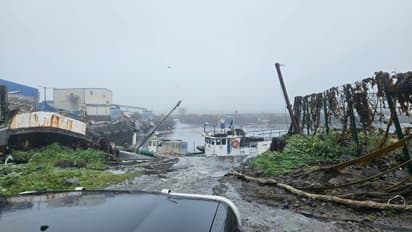
Within minutes, tsunami warnings went out for Russia, Japan, Alaska, Hawaii, Guam, and other Pacific islands. Waves measuring between 3 to 4 metres were reported in Kamchatka, prompting authorities to evacuate coastal towns like Severo-Kurilsk. Japan's Meteorological Agency also issued alerts, warning of potential waves of up to 3 metres.
In the United States, parts of the West Coast were placed on alert, though the tsunami threat there was seen as less severe. Still, the event reminded many just how volatile the Pacific Ring of Fire remains, a belt of tectonic activity responsible for some of the world's most devastating earthquakes and volcanic eruptions.
‘Everything began to shake and fall’: Social media explodes with videos
As sirens rang out and people fled inland, horrifying videos began circulating online. From shaking houses and collapsing office ceilings to footage of receding shorelines, the internet was soon flooded with dramatic clips.
One user posted, "Tsunami warnings were issued across the Pacific, including Hawaii, Japan, and the U.S. West Coast. Scary. Videos showing the shaking from the M8.7 earthquake that hit off the coast of Kamchatka, Russia."
"Earthquake near Russia has been raised to 8.7 magnitude, and a tsunami alert has been spread to Alaska, Japan, and Russia," the user added.
And a third added, “USGS has upgraded the earthquake to a massive 8.7 magnitude! The powerful quake struck off the eastern coast of Russia. There is a serious tsunami threat.”
What’s next?
Authorities say the chances of another major quake in the next 48 hours are low, citing pressure redistribution along nearby fault lines. But as is often the case with tectonic regions like Kamchatka, the situation remains fluid and the region will remain on edge for some time.