Drone Captures Massive Tsunami Flooding Russian Town After Kamchatka's Biggest Quake Since 1952 (WATCH)
Synopsis
A massive 8.8 earthquake struck Russia’s Kamchatka Peninsula, triggering tsunami waves that flooded Severo-Kurilsk. Drone footage shows submerged streets as over 2,000 people were evacuated. Authorities are warning of powerful aftershocks.
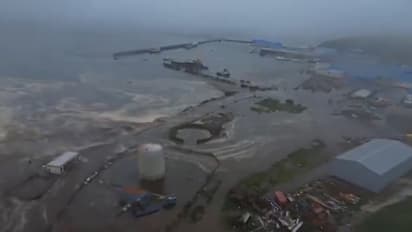
A massive earthquake measuring 8.8 on the Richter scale hit the Kamchatka Peninsula in Russia on Wednesday. It is the strongest quake in the area since 1952. Soon after, tsunami waves hit the nearby port town of Severo-Kurilsk.
Thousands of people were quickly evacuated. The Russian Geophysical Survey released drone footage that showed floodwaters rushing through streets and buildings almost entirely submerged.
Town submerged, residents evacuated
Severo-Kurilsk, which has around 2,000 residents, was directly in the path of the tsunami. Russian officials said the tsunami waves reached up to 12 feet (about 4 metres).
"The tsunami flooded parts of the port town of Severo-Kurilsk," said the emergency ministry. Videos on Russian social media showed boats pushed inland and streets turned into rivers.
Luckily, early warnings helped avoid major injuries. Some people were hurt, but state media said none of the injuries were serious.
Residents recall moments of fear
People living near the coast described terrifying moments. “The walls were shaking. We had a suitcase packed with clothes and water. We just grabbed it and ran,” one local told state media Zvezda.
Governor Vladimir Solodov urged residents to stay away from the shore. “A tsunami warning has been issued,” he said. “Everyone should follow loudspeaker announcements and not go near the coastline.”
Warnings continue as aftershocks rattle region
The earthquake’s epicentre was in the same area as a deadly 9.0 quake that caused a Pacific-wide tsunami in 1952. Experts warned that more strong aftershocks are expected, possibly reaching up to 7.5 magnitude.
Six aftershocks have already hit the region. One of them measured 6.9 and another was 6.3. Authorities continue to monitor the situation closely.
The tsunami waves triggered warnings in many countries, including the United States, Japan, China, and New Zealand. People in those areas were also advised to stay away from coastal zones.
The quake and tsunami have once again shown how powerful nature can be, especially in areas near tectonic fault lines.