India practices 'Vasudhaiva Kutumbakam': Jaishankar on UNSC bid
Synopsis
EAM S Jaishankar launched India's campaign for the UNSC 2028-29 seat, stating India practices 'Vasudhaiva Kutumbakam' through its global contributions in maritime security, disaster relief, health security, and advocacy for the Global South.
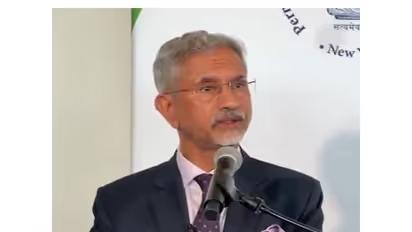
External Affairs Minister S Jaishankar on Monday (local time) highlighted India's contributions to global peace, humanitarian assistance, and development partnerships, stating that New Delhi does not merely advocate the principle of "Vasudhaiva Kutumbakam" but actively puts it into practice. Addressing member states at the UN Headquarters while launching the country's campaign for a non-permanent seat on the United Nations Security Council (UNSC) for the 2028-29 term, Jaishankar said India's approach to global engagement is reflected in its contributions to maritime security, disaster relief, health security, food assistance, and peacekeeping operations.
India Practices 'Vasudhaiva Kutumbakam'
Highlighting India's role in maritime security, the External Affairs Minister noted that Indian forces regularly contribute to anti-piracy, counter-narcotics, and anti-trafficking operations while protecting vital sea lanes across the Indo-Pacific. These operations span the northern and southern Arabian Sea, the Gulf of Aden, the Malacca Strait, and the Gulf of Guinea. "When India advocates 'Vasudhaiva Kutumbakam'--that is, the 'world as a family'--as an approach, we don't simply preach; we practice it as well. A few recent examples of our contribution to global well-being: One, in maritime security, India makes wide-ranging and regular contributions, including in anti-piracy, counter-narcotics, and anti-trafficking operations. Apart from the fusion centre... our forces are protecting sea lanes across the Indo-Pacific, specifically the northern and southern Arabian Sea, the Gulf of Aden, the Malacca Strait, and even in the Gulf of Guinea. A long record of peacekeeping is today extended to offering training and capacity building to 98 nations at the Delhi Centre for United Nations Peacekeeping," he said.
From Disaster Relief to Health Security
Jaishankar emphasised that India has consistently acted as a first responder during humanitarian crises, citing relief operations following Cyclone Ditwa in Sri Lanka and Hurricane Melissa in Jamaica. He said India's disaster response teams and emergency supplies have made a tangible difference in saving lives in affected nations. He also outlined India's contributions to global health and food security, noting that New Delhi has supplied vaccines, medicines, and life-saving equipment to countries including Afghanistan, Tanzania, Madagascar, the Maldives, Fiji, Vanuatu, and Papua New Guinea. This is in addition to extending medical assistance to the Africa Centres for Disease Control and Prevention (Africa CDC) to help contain Ebola. Furthermore, he noted that India has responded to food security crises in countries such as Sierra Leone, Madagascar, Mozambique, and Malawi. "As a first responder, whether it was Cyclone Ditwa in Sri Lanka or Hurricane Melissa in Jamaica, India stepped forward decisively. Our prompt mobilization, disaster response teams, and emergency supplies have made a difference to the lives of many. In advancing health security, India is building further on vaccine supplies to the Global South. We have gifted medicines and life-saving equipment to a range of destinations, among them Afghanistan, Tanzania, Madagascar, the Maldives, Fiji, Vanuatu, and Papua New Guinea. The medical assistance for Africa CDC for the containment of Ebola is yet another example. In pursuance of food security, we have responded to crisis situations in a number of countries; Sierra Leone, Madagascar, Mozambique, and Malawi are some examples," Jaishankar said.
Championing a Pluralistic World Order
Emphasising India's commitment to a more inclusive global order, Jaishankar stated that peace is strengthened through participation rather than domination. "Like many nations that emerged independent again after decolonisation, India is convinced that peace is strengthened by participation, not achieved by domination. The world is inherently pluralistic, and the United Nations itself is constituted on the basis of sovereignty," he said.
The minister added that India has consistently sought to amplify the concerns of developing nations through initiatives such as the Voice of the Global South Summits and by ensuring the African Union's inclusion as a permanent member of the G20 during India's presidency. "Our development partnership spans more than 100 member states across Asia, Africa, the Pacific, Latin America, and the Caribbean," Jaishankar said, concluding that India has consistently highlighted the adverse impact of conflicts on food, fuel, and fertiliser security, and will continue to represent the concerns of the Global South regarding international peace and security before the Security Council. (ANI)