Jaishankar calls for deeper India-South Korea ties in fragmented world
Synopsis
At the Jeju Forum, EAM S. Jaishankar urged deeper India-South Korea cooperation, noting their 'ships to chips' complementarities can help build a resilient global order and reinvent cooperation in a fragmented world.
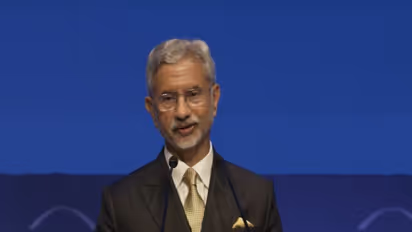
External Affairs Minister S. Jaishankar on Thursday called for deeper cooperation between India and South Korea, saying the two countries have complementarities across a wide range of sectors "from ships to chips" that can contribute to a more resilient and cooperative global order.
Delivering the keynote address at the Jeju Forum for Peace and Prosperity 2026 during his two-day visit to the Republic of Korea (June 24-25), Jaishankar said the world must adapt to a new reality of fragmentation while finding fresh ways to cooperate. "This forum is discussing a fragmented world as a problem and reinventing cooperation as a solution. I agree with both the diagnosis and the treatment," he said. He added, "Having said that, let us recognise two facts: One, that fragmentation is here to stay. And two, that perhaps it is not altogether bad, in some ways even good. After all, it means less dominance, more space and greater democratisation."
A World of Integration and Fragmentation
Jaishankar said today's world is defined by growing economic integration and interdependence despite geopolitical tensions. He said, "What characterises our current existence above all is the degree of economic integration and interdependence. The world is increasingly about supply chains, their efficiency and their resilience. This is not just about goods, it is equally about resources."
He noted that technology has become a powerful integrating force across borders and that artificial intelligence would further accelerate those trends. He said, "The advent of AI, artificial intelligence, will only accelerate these trends since the capture of data and the deployment of models is inherently transnational."
At the same time, he stressed that global challenges such as pandemics, terrorism and climate-related disasters require collective action. He added, "Now paradoxically, the challenges we confront have only further strengthened the centripetal side, whether it is pandemics like COVID-19, acts of terrorism or the impact of extreme climate events. These cannot be contained within political jurisdictions. International cooperation is therefore a must."
Forces Driving Fragmentation
Invoking India's civilizational ethos, Jaishankar said, "In India, we know that traditionally as Vasudhaiva Kutumbakam, the world is a family." Warning about the forces driving fragmentation, he said, "The natural play of commerce is increasingly influenced by calculations of strategy. Now this spills over into the domain of connectivity as well, whether we think of it as choke points or whether we are talking about specific projects."
He also criticised practices that restrict the growth prospects of developing countries. He said, "The right to industrialise, indeed the capacity and the opportunity to do so, this is being denied to many developing states by the manipulation of competitiveness and by restrictions of market access. This is but another facet of exercising dominance and retaining control."
Summing up the international landscape, Jaishankar said, "The world is today witnessing greater weaponisation, weaponisation of everything. We are seeing higher risk-taking and a politics that is suited to, in a way driven by, the social media era."
Reinventing Cooperation: A Five-Step Approach
"As the interests of a few are openly prioritised, the costs to the many are less considered. This can only be countered, and it must be countered, by cooperation on more issues with greater players."
The minister outlined five steps to reinvent cooperation in a fragmented world, ie, "de-risking the international economy and diversifying production and supply chains," "forging new understandings and closer cooperation among influential nations," protecting international law and regimes such as UNCLOS, empowering the Global South with greater opportunities, and advancing reformed multilateralism.
India-South Korea: A Partnership for the Future
Linking those ideas directly to India-South Korea relations, Jaishankar said, "These five factors make a powerful case why India and the Republic of Korea must cooperate more closely."
"We have complementarities, we have many complementarities in many fields, from ships to chips, and also health, infrastructure or defense, which are just waiting to be exploited."
He added that "the value of our economic and technology partnership, that of political and strategic cooperation, and particularly of closer people-to-people ties" had been the focus of his bilateral meetings in Seoul a day earlier, underscoring the growing importance of the India-South Korea partnership in an increasingly fragmented world. (ANI)
(Except for the headline, this story has not been edited by Asianet Newsable English staff and is published from a syndicated feed.)