Iran Warns Against Escalation as Trump Urges Allies to Escort Ships
Synopsis
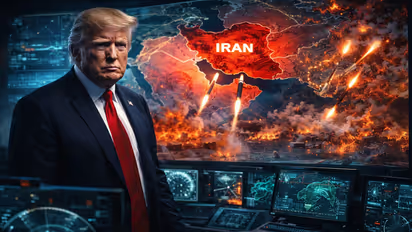
Iran warned countries against escalating its conflict with the US and Israel after Donald Trump urged allies to escort oil tankers through the Strait of Hormuz. Tehran said it has evidence of attacks launched from US bases in Gulf nations.
Iran on Sunday warned countries against getting involved in its war with the United States and Israel, after President Donald Trump urged world powers to escort oil tankers through the Strait of Hormuz chokepoint in the Gulf.
Tehran also sent a stern message to its Arab neighbours, telling them that the Islamic republic has what its foreign minister called "ample evidence" that US bases on their territories were being used to launch attacks.
"This war will end when we are certain that it will not be repeated and that reparations will be paid," Iranian Foreign Minister Abbas Araghchi told Arabic-language news platform Al-Araby Al-Jadeed.
"We experienced this last year: Israel attacked, then the United States," he said, recalling Israel's 12-day air war in June last year, which briefly drew in US forces for a night of strikes on Iranian nuclear sites.
Energy prices have soared across the world since Iran responded to the new US-Israeli campaign by threatening shipping though the Strait of Hormuz, which usually sees passage of 20 percent of global oil and gas exports to the global market.
Trump responded by urging "China, France, Japan, South Korea, the UK and others" to send ships to escort tankers, while the US military continues to pound drone, boat and missile launch sites in Iran on the north shore.
Just for fun
But the countries he listed have given only guarded responses, and Araghchi, in a call with French counterpart Jean-Noel Barrot, warned them to "refrain from any action that could lead to escalation and expansion of the conflict".
The UK defence ministry was non-committal, saying "we are currently discussing with our allies and partners a range of options to ensure the security of shipping in the region".
Britain's minister for energy security, Ed Miliband, told the BBC the "plan now has to be to de-escalate the conflict... We are talking to our allies. There are different ways in which we can make maritime shipping possible."
South Korea said it was monitoring Trump's remarks on social media, while the policy chief of Japan's ruling party, Takayuki Kobayashi, said the bar for sending Japanese navy ships to the region under existing laws was "extremely high".
Global oil prices have surged by 40 percent as Iran has choked off the vital sea passage and attacked energy and shipping industry targets in its Gulf neighbours.
The strikes were in retaliation for the US and Israeli air campaign that killed its supreme leader, triggering a war across the Middle East.
As global markets reel, Trump has doubled down, telling NBC News in a weekend interview that he thought Tehran was keen to come to the table but that the US was fighting on to force better terms.
He said he might, again, bomb targets on Iran's oil hub, Kharg Island, "just for fun".
"Iran wants to make a deal, and I don't want to make it because the terms aren't good enough yet," Trump told NBC News.
Araghchi, in a separate interview with the US network CBS's "Face the Nation", denied that Tehran was asking for a deal.
"We are stable and strong enough. We are only defending our people," Araghchi said. "We don't see any reason why we should talk with Americans, because we were talking with them when they decided to attack us."
Cafes reopen
Despite the hardline talk from all sides, residents of Tehran were able to go about their work week in the most normal atmosphere since the start of the war on February 28.
Traffic was busier than last week and some cafes and restaurants had reopened.
One resident whizzed down the street on an electric hoverboard, and more than a third of stalls in the Tajrish bazaar, a popular shopping hub in the north of the capital, had reopened, five days before Nowruz, the Persian New Year.
Some shoppers queued at ATMs to withdraw cash. Online operations at Bank Melli, one of the country's largest, had been paralysed in recent days.
It was a similar story outside the capital. In an interview from Tonekabon, a city in Mazandaran province on the Caspian Sea, 49-year-old Ali told AFP that shops are open and crowded despite steep price rises.
"Only the main square is closed every night, and government demonstrations take place," he said, adding that only Iran's national internet was working, without outside connections.
Players drop asylum bids
The captain of the Iranian women's football team, which played in the Asian Cup in Australia, has withdrawn her bid for asylum, state media said Sunday.
That made her the fifth member of the delegation to change her mind, leaving just two seeking sanctuary.
The captain, Zahra Ghanbari, was on her way back to Iran via Malaysia, the IRNA news agency said.
Rights groups have repeatedly accused Iranian authorities of pressuring athletes abroad by threatening relatives or with the seizure of property if they defect or make statements against the Islamic republic.
More than 1,200 people have been killed by US and Israeli strikes, according to Iranian health ministry figures that could not be independently verified.
The UN refugee agency says up to 3.2 million people have been displaced in Iran.
The Pentagon says more than 15,000 targets in Iran have been hit by US and Israeli forces.
(Except for the headline, this story has not been edited by Asianet Newsable English staff and is published from a syndicated feed)