Iran to Face 'Largest Strike Yet' as US Claims Decisive Win: Hegseth
Synopsis
US Secretary of War Pete Hegseth warned Iran of its 'largest strike package yet,' asserting the US is winning the conflict decisively. He stated over 7,000 Iranian targets have been struck, severely degrading its military capabilities.
US Vows 'Largest Strike Yet,' Claims Decisive Win
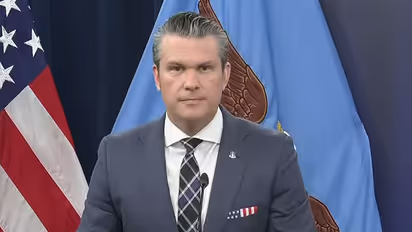
US Secretary of War Pete Hegseth on Thursday warned that Iran will face the "largest strike package yet" today, asserting that the United States is winning the ongoing conflict "decisively and on our terms." Addressing a Pentagon briefing here, Hegseth said the military campaign, code-named Operation Epic Fury, against Iran is "laser focused" and "decisive," with objectives set directly by the US administration remaining unchanged since the start of operations. "Epic Fury is different. It's laser-focused. It's decisive. Our objectives, given directly from our America First President, remain exactly as they were on Day One...We're winning -- decisively and on our terms," Hegseth said.
He further stated that since the start of the war on February 28, over 7000 Iranian targets, including military and energy infrastructure, have been struck. "To date, we've struck over 7,000 targets across Iran and its military infrastructure. That is not incremental. That is an overwhelming force applied with precision. And again, today will be the largest strike package yet, just like yesterday was. As I've said from day one, our capabilities continue to build. Iran's continued to degrade. We're hunting and striking, bringing death and destruction from above," the Secretary of War stated.
Iran's Military Capabilities 'Flattened'
Hegseth highlighted the significant degradation of Iran's military capabilities, including flattened air defences, severely damaged missile and drone production lines and hundreds of defence industrial bases struck directly. He added that Iran's ability to manufacture new ballistic missiles has taken the hardest hit, with ballistic missile attacks against US forces down 90 per cent since the conflict began. "Iran's air defence is flattened. Iran's defence industrial base, the factories, the production lines that feed their missile and drone programs, being overwhelmingly destroyed. We've hit hundreds of their defence industrial bases directly. Their ability to manufacture new ballistic missiles has probably taken the hardest hit of all. Ballistic missile attacks against our forces are down 90 per cent since the start of the conflict," he added.
Naval Assets Crippled
The Secretary also pointed to major naval losses, stating, "We've damaged or sunk over 120 of their Navy ships, with battle damage assessments pending for many more. Their submarines, once numbering 11, are gone. Their military ports are crippled."
Pentagon Details Precision Strikes
Chairman of the Joint Chiefs of Staff General Dan Caine provided additional details, saying the US military has deployed 5,000 lb penetrator weapons on underground storage facilities holding coastal defence cruise missiles. "We continue to hunt and destroy mine storage facilities, naval ammunition depots, and afloat assets, including more than 120 vessels and 44 minelayers. We're flying further east and penetrating deeper into Iranian airspace to neutralise one-way attack garrisons, destroying Iran's ability to project power outside its borders," he said.
Conflict Background: Assassination and Retaliation
The Pentagon officials emphasised that US operations are ongoing, with capabilities continuing to build, and described the strikes as a sustained effort to decisively degrade Iran's military infrastructure and limit its ability to attack US forces or regional partners. The development comes amid the escalating tensions and conflict that began on February 28 with the killing of 86-year-old Iran's Supreme Leader, Ayatollah Ali Khamenei, in joint military strikes by the US and Israel, after which Iran, in its retaliation, targeted Israeli and US assets in several Gulf countries and Israel, causing disruption in the waterway and affecting international energy markets and global economic stability. Due to the conflict in the region, Iran has virtually closed the Strait of Hormuz, a critical transit route for global energy supply. Following the death of Ali Khamenei, Mojtaba Khamenei, son of the former leader, was appointed as the new Supreme Leader of the Islamic Republic. (ANI)