Iran: No opening of Strait of Hormuz until our 7 conditions are met
Synopsis
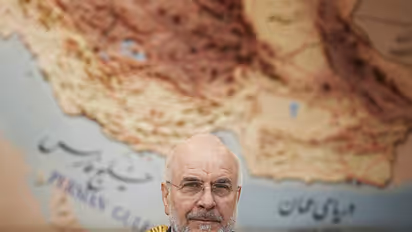
Iran's Parliament Speaker, Mohammad Bagher Ghalibaf, stated the Strait of Hormuz will not reopen until 7 conditions are met, stressing that Tehran will pursue both military action and negotiation at the appropriate times to achieve its goals.
No Reopening of Strait of Hormuz Until Conditions Met: Ghalibaf
Iran's Parliament Speaker Mohammad Bagher Ghalibaf said there would be no opening of the Strait of Hormuz until Iran's seven conditions were met, adding that Tehran must pursue both military action and negotiations at the appropriate time.
'Fight and Negotiate' Strategy
While addressing the Iranian Parliament, Ghalibaf said, "We believe that the duality of war or negotiation is not real, but that we must both fight and negotiate. We must fight sensibly and decisively and negotiate with authority and rationality at the right time."
Ghalibaf said Iran must use its military power to push back its adversary and consolidate battlefield gains through diplomacy. "That is, at the right moment, with all the military power we have, we must push back the enemy and deal him fatal blows. But when we have achieved a significant field victory, and the enemy is weak, we must consolidate these advantages with the tools of diplomacy until we reach the stage of deterrence by imposing defeat on the enemy and also strengthening the components of our power," he said.
He said Iran's positions in the diplomatic arena were "completely clear, rational, and non-negotiable", adding that its conditions had been conveyed to the other side through mediators. "Today, in the diplomatic arena, our positions are completely clear, rational, and non-negotiable. The transmission of messages and explanation of our conditions through mediators has been done explicitly to the other side, and the enemy knows very well that the path of deception and unilateral imposition is closed," Ghalibaf said.
Iran's 7 Conditions for Negotiation
He further said the Strait of Hormuz would not be reopened until Iran's conditions were fulfilled, including recognition of what he called the legitimate rights of the Iranian people and implementation of US commitments. "And until these conditions are fulfilled, the legitimate rights of the Iranian people are recognised, and the commitments of the Americans are implemented, there will be no opening for returning to the previous conditions of negotiation and the opening of the Strait of Hormuz," the Parliament Speaker added.
Ghalibaf's remarks come as Iran has conveyed seven conditions to the United States through Qatari mediators for starting negotiations to end the ongoing war, while warning that Tehran is prepared for a “decisive war” if Washington rejects its demands.
According to Al Jazeera, Mohsen Rezaei, secretary of Iran's Supreme National Security Council, said that Qatar had conveyed Iran's conditions to Washington and Tehran was awaiting US President Donald Trump's response. “We remain in contact with the mediator Qatar, which has conveyed our conditions to Washington with the aim of ending the war. We are awaiting President Trump’s response,” Rezaei said.
Specific Demands Outlined
Rezaei said Iran's conditions included an end to the war on all fronts, the release of frozen Iranian funds and an end to the naval blockade. “Our conditions are an end to the war on all fronts, the release of our frozen funds and an end to the naval blockade,” he said.
In a separate post on X, Rezaei said Iran had announced seven conditions for beginning negotiations with Washington, adding that Tehran's position was clear. "Iran has announced 7 conditions for starting any negotiations to the US government. Tehran's message is clear and unambiguous; if Washington wants to escape the quagmire it has created for itself and avoid getting further entangled in it, it has no choice but to accept Iran's rights and conditions," he wrote.
Warning of 'Decisive War' and Military Preparedness
“It is in Washington’s interest to accept these conditions. Trump’s threats will not achieve any results. We are prepared for a decisive war,” Rezaei told Al Jazeera.
Qatar and Pakistan have been working to re-establish negotiations between Tehran and Washington since the expiry of a memorandum of understanding last month. Regional countries have also been seeking an end to the conflict that began after the US and Israel launched strikes against Iran in late February.
Rezaei did not rule out the possibility of another US strike, saying it was “very much on the cards” based on Iranian military assessments. He said Tehran was prepared for such a scenario and that Iran's military planning had changed following two earlier rounds of fighting.
The Iranian security chief said Tehran's current planning was focused on US naval assets stretching from the Gulf through the Gulf of Oman and into the Arabian Sea. He claimed Iran had also recently test-fired a multi-warhead anti-ship missile near a US vessel or aircraft carrier.
Rezaei warned that any future Iranian response could be extensive, targeting US bases in the region as well as American commercial interests and companies operating locally. Asked whether the war could end soon, Rezaei said, "In practical terms, the war is still going on,” while adding that Tehran was pursuing a strategy aimed at bringing the conflict to an end “as soon as possible”. (ANI)
(Except for the headline, this story has not been edited by Asianetnews Editorial staff and is published from a syndicated feed.)