Iran blames US, Israel for Hormuz insecurity, urges diplomacy
Synopsis
Iranian Foreign Minister Seyyed Abbas Araghchi blamed US and Israeli military aggression for the mounting insecurity in the Strait of Hormuz, asserting that regional issues cannot be resolved through force but require diplomatic solutions.
Iran, Russia Decry Foreign Military Intervention
Iranian Foreign Minister Seyyed Abbas Araghchi on Monday warned that mounting insecurity in the strategic Strait of Hormuz was the "inevitable result" of military aggression by the United States and Israel against Iran, asserting that regional crises could not be resolved through the use of force.
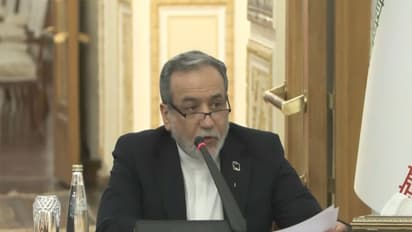
Addressing a joint press conference in Tehran alongside visiting Russian Foreign Minister Sergey Lavrov, Araghchi reaffirmed that Tehran and Moscow shared a common position against foreign military intervention. "Our common view with Russia is that regional issues have no military solution. They must be pursued through diplomacy and political solutions," Araghchi said, according to the remarks shared by the Iranian Ministry of Foreign Affairs on Telegram.
Blame on US, Israel for Regional Destabilisation
Placing the blame for destabilisation directly on Washington and Tel Aviv, Araqchi warned that ongoing regional conflicts continue to threaten international shipping lanes and regional stability. "The insecurity in the Strait of Hormuz is the inevitable result of the military aggression of the United States and the Zionist regime against Iran, and it continues in various forms," Araqchi told reporters, adding that the "genocide in Palestine and the dangerous expansionism of the Zionist regime must be stopped" immediately. Turning to the situation in Palestine, Lebanon, and Yemen, the Iranian diplomat emphasised the urgent need for international intervention to halt Israeli attacks. "The genocide in Palestine and the dangerous expansionism of the Zionist regime must be stopped," Araghchi urged.
Shared Concerns Over Caspian Sea, Afghanistan
In addition to southern maritime routes, Araghchi revealed that both Iran and Russia share grave concerns over emerging security threats in the Caspian Sea, specifically highlighting recent attacks on commercial shipping vessels. "We have serious concerns about insecurity in the Caspian Sea, including attacks on Iranian and Russian ships," Araghchi stated.
Addressing neighbouring security concerns, Araqchi noted that Tehran and Moscow remain aligned on stabilising Afghanistan, saying, "We agree on Afghanistan, reducing tensions between Kabul and Islamabad, and confronting terrorist threats."
'Strategic' Bilateral Relations
Welcoming Lavrov and his delegation to Tehran, Araghchi highlighted the implementation of the comprehensive Strategic Partnership Agreement signed by the presidents of the two countries, describing bilateral relations as strategic and increasingly significant. "I welcome Mr. Lavrov, the Honorable Minister of Foreign Affairs of the Russian Federation, and his accompanying delegation. We are pleased to host them once again in Tehran," Araghchi said.
"We had a very important and fruitful meeting today. The Iran-Russia relationship is a strategic one, and after the implementation of the Strategic Partnership Agreement between the two presidents, our relationship has taken on more important dimensions." He noted that detailed discussions took place to identify "practical solutions for expanding relations in the economic, commercial, political and cultural fields" between the two nations.
"Fortunately, relations between the two countries are progressing well and there are no serious obstacles to expanding relations. We have continuous consultations with each other in the political field," Araghchi affirmed.
Concluding his remarks, Araghchi pledged that Iran and Russia will continue joint diplomatic efforts on global platforms, adding, "We will continue our cooperation on international issues, mainly in confronting America's belligerent unilateralism."
(Except for the headline, this story has not been edited by Asianetnews Editorial staff and is published from a syndicated feed.)