India-Africa Summit postponed due to Ebola outbreak, MEA announces
Synopsis
On Africa Day 2026, Minister Kirti Vardhan Singh hailed India-Africa ties. Meanwhile, the MEA postponed the Fourth India-Africa Forum Summit in New Delhi due to an Ebola outbreak in Africa, designated a PHEIC by the WHO.
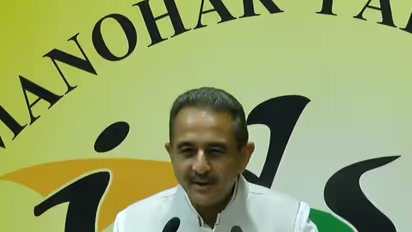
Commemorating Africa Day 2026, Minister of State for External Affairs Kirti Vardhan Singh on Thursday delivered a keynote address at the Manohar Parrikar Institute for Defence Studies and Analyses, detailing the deep-rooted historical bonds and rapidly evolving strategic alignment between India and the African continent. Speaking to an eminent gathering of diplomats, high commissioners, and international policy experts, the minister highlighted the multi-dimensional expansion of bilateral ties, which comes at a crucial diplomatic juncture.
India-Africa Summit Postponed Amid Ebola Outbreak
Providing immediate global context to these evolving dynamics, the Ministry of External Affairs (MEA) announced on Thursday that the Fourth India-Africa Forum Summit (IAFS-IV) in New Delhi has been postponed due to the Ebola outbreak in Africa. The critical diplomatic gathering was deferred following detailed deliberations convened between Indian administrative authorities, the Chairperson of the African Union, and the African Union Commission to evaluate the feasibility of hosting the high-profile assembly and its ancillary events under current conditions.
This major diplomatic decision comes as global attention has once again shifted to Ebola following the World Health Organisation's decision to designate the escalating crisis across Congo and Uganda as a Public Health Emergency of International Concern (PHEIC). Far from being a monolith, the virus manifests through distinct viral strains, each possessing unique characteristics regarding its lethality, how rapidly it spreads, and its vulnerability to medical interventions. Driving this specific health crisis is the Bundibugyo variant, a less common iteration of the pathogen that historically emerges far less often than the notoriously virulent Zaire strain, which fueled the catastrophic West African epidemic from 2014 to 2016.
India-AU Reaffirm Health Cooperation
According to an official communique released by the Ministry of External Affairs, the Government of India and the African Union exchanged views on the evolving health situation in parts of Africa. Both sides reaffirmed the importance of continued cooperation in strengthening public health preparedness and response capacities across the continent, including through support to Africa CDC and relevant national institutions.
In light of the unfolding medical emergency, New Delhi has re-emphasised its unwavering alignment with African populations and their respective administrations. Furthermore, India has voiced its complete preparedness to provide material and strategic assistance to operations spearheaded by the Africa CDC, ensuring all actions remain perfectly aligned with the shared commitment to an Africa-led response.
The scheduling of fresh timelines for the multilateral conference and its supplementary conventions remains under review. The MEA indicated that the new dates for the Summit and its associated meetings will be finalised through mutual consultations and communicated in due course.
Enduring Partnership and Historical Ties
Underscoring the deep historical and diplomatic ties that bind the two regions together despite the temporary delay, the official document emphasised a mutual dedication to joint advancement. "India and Africa reaffirmed their longstanding partnership founded on solidarity, mutual respect, South-South cooperation, and a shared commitment to peace, development, prosperity, and the well-being of their peoples," read the statement.
This shared commitment was mirrored in the minister's address, which focused heavily on the enduring nature of the relationship. Welcoming the attendees, Singh acknowledged Director General of the Manohar Parrikar Institute for Defence Studies and Analyses, Ambassador Sujan R. Chinoy, alongside the Dean of the African and Arab Diplomatic Corps in New Delhi, Ambassador Mohamed Maliki, and various African envoys.
Reflecting on the profound significance of the global occasion, the minister remarked, "Africa Day celebrates the spirit of liberation, unity, resilience, and the indomitable will of the people of Africa."
Tracing the historical trajectories of both geographies, Singh observed that as global partners mark the founding of the Organisation of African Unity, the precursor to the African Union, they reflect upon a journey of struggle, resilience, and transformation that echoes India's own freedom struggle. "India and Africa are bound by a shared legacy of resistance against colonialism and apartheid, and today we are united by a common aspiration for peace, prosperity, and inclusive development," the minister stated.
Underscoring the contemporary relevance of the conference theme, "Africa-India Partnership: Towards a Common Future," the minister pointed out that the strategic destinies of the two regions remain inextricably linked in an increasingly interconnected global architecture. "The progress of one-sixth of humanity in India is inseparable from the advancement of our brothers and sisters in Africa," Singh said, adding that the joint partnership stands for peace, fairness, sustainability, and inclusive growth at a time of escalating geopolitical divisions.
Strategic, Defence, and Security Cooperation
Describing Africa as the ultimate "continent of the future", powered by its vibrant youth demographic and the trade potential of the African Continental Free Trade Area (AfCFTA), Singh highlighted India's geopolitical perspective of the continent. "India views Africa not merely as a partner, but as a close maritime neighbour connected through the Indian Ocean, a shared space that has facilitated trade, cultural exchange, and civil civilisation ties for centuries," the minister declared.
Given the academic focus of the host institution, the minister placed special emphasis on the robust defence and security architecture shaping the relationship. India's tangible contribution to continental stability is anchored by the deployment of over 5,000 Indian peacekeepers in various United Nations operations. "We take particular pride in the pioneering role played by Indian women peacekeepers, who formed the United Nations' first-ever all-female police unit in Liberia," Singh highlighted, while also pointing to structural frameworks like the India-Africa Defence Ministers' Conclave and Vision MAHASAGAR that secure shared maritime zones.
Economic and Development Partnership
On the economic front, India has emerged as a premier trading and investment ally for the continent, boasting a cumulative investment footprint exceeding 80 billion USD. Singh explained that India's Duty-Free Tariff Preference Scheme provides duty-free access on 98.2 per cent of India's tariff lines for 33 African Least Developed Countries, further reinforcing a demand-driven development model that includes 190 Lines of Credit worth over 10 billion USD extended across 41 African nations.
The humanitarian and digital collaboration pillars have seen equal acceleration over the last decade. New Delhi has offered more than 70,000 scholarships and capacity-building opportunities to African partners under flagship initiatives like the Indian Technical and Economic Cooperation Programme. Furthermore, during the peak of the global pandemic, India remained a reliable friend, supplying over 40 million doses of Made-in-India vaccines to 42 African countries.
Looking towards the global green transition, the minister outlined how India's scalable technology is pairing with Africa's massive renewable energy potential through platforms like the International Solar Alliance (ISA) and the Global Biofuels Alliance (GBA). Simultaneously, technological democratisation is underway as India shares its Digital Public Infrastructure, with the Modular Open Source Identity Platform (MOSIP) currently supporting digital identity roll-outs across 19 African nations.
Geopolitical Alignment and Future Vision
Geopolitically, New Delhi has consistently championed African representation on the world stage. The minister recalled how, during India's G20 Presidency, Prime Minister Narendra Modi successfully secured permanent membership for the African Union in the G20. India has also supported the inclusion of Egypt and Ethiopia within BRICS, while pushing for comprehensive reform of the United Nations Security Council in line with the Ezulwini Consensus. "We also value the continued support of our African partners for India's aspiration to become a permanent member of an expanded UN Security Council," Singh added.
Looking forward, the minister emphasized that the future of the partnership rests on a shared vision for global governance and the upcoming generation. "The future of India-Africa cooperation lies in our collective ability to shape a more balanced, inclusive, and multipolar world order," Singh affirmed, emphasizing the role of youth, education, and skills.
New Delhi to Host First International Big Cat Alliance Summit
In a major policy disclosure pointing to a new frontier in global environmental statecraft, the minister announced that New Delhi will play host to the First International Big Cat Alliance (IBCA) Summit on June 1, 2026, marking a historic milestone where world leaders will convene exclusively to deliberate on multi-continental wildlife conservation. "The major outcome of the IBCA Summit will be the 'New Delhi Declaration on Big Cat Conservation', which will provide guiding principles for big cat conservation at global level."
Singh expressed confidence that the dynamic ideas generated during the day-long conference would ultimately help formulate the shared future of nearly three billion people across both geographies.
(Except for the headline, this story has not been edited by Asianet Newsable English staff and is published from a syndicated feed.)