India Slams Pakistan's 'Fitna al Hindustan' Disinformation at UN
Synopsis
India lambasted Pakistan at the UN for its 'Fitna al Hindustan' disinformation campaign. The Indian envoy called it a state-sponsored 'factory of hate' to deflect from domestic crises and condemned its deadly cross-border military operations.
India Slams Pakistan's 'Fitna al Hindustan' Disinformation Campaign
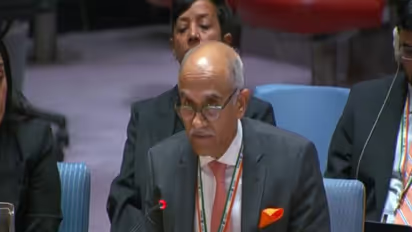
India has strongly criticised Pakistan at the United Nations for propagating state-sponsored disinformation by labelling militant outfits operating inside its own territory as "Fitna al Hindustan". Speaking at a United Nations Security Council session focusing on the situation in Afghanistan, India's Permanent Representative to the UN, Ambassador Parvathaneni Harish, stated that Islamabad was merely attempting to deflect blame onto New Delhi.
Islamabad had previously designated multiple active militant groups under this specific moniker, alleging that they were functioning under Indian direction, though it failed to produce any evidence to substantiate the claims. The Indian envoy countered that this rhetoric was intentionally manufactured to deceive both the Pakistani public and the global community.
Ambassador Harish observed, "Pakistan coming up with official notifications, directing its government agencies to start referring to groups inside its own borders as 'Fitna al Hindustan', is nothing but officially sponsored misinformation and disinformation dressed in religious terminology." He argued that this narrative serves as a deliberate strategy by the Pakistani establishment to sustain animosity against India.
Terming the apparatus "an organised factory of hate", the envoy stated that the campaign seeks to distract the Pakistani population from pressing domestic political and economic crises by focusing on external adversaries.
The Indian representative further targeted Pakistan's political framework and the dominant role played by its military in governance, pointing to recent constitutional amendments as clear indicators of expanding military dominance over civilian authorities.
Condemnation of Cross-Border Military Operations
Shifting the focus to regional security, New Delhi condemned Islamabad's cross-border military operations, holding Pakistan accountable for significant civilian casualties resulting from its aerial assaults in Afghanistan. The envoy noted, "Let me reiterate. Dressing up a massacre as a military operation does not absolve the perpetrator. Killing, maiming and orphaning civilians is not counter-terrorism."
He continued, "Espousing high principles of international law and Islamic solidarity while mercilessly carrying out air strikes during the holy month of Ramadan is the perfect example of hypocrisy."
Ambassador Harish asserted that Pakistan possesses a protracted track record of holding its neighbours responsible for its own internal shortcomings.
Escalating Pakistan-Afghanistan Hostilities
This diplomatic showdown occurs amid a severe escalation in hostilities between Pakistan and Afghanistan. Earlier this year, UN records indicated that Pakistani airstrikes in Afghan territory killed a minimum of 13 civilians, including women and children, triggering the most intense border confrontation between the two nations in years.
By March, the UN documented that the cross-border strikes and subsequent military manoeuvres had left at least 42 civilians dead and 104 wounded, whilst forcing over 100,000 individuals to flee their homes.
Friction intensified dramatically following allegations by Afghan officials that a Pakistani airstrike on a Kabul drug rehabilitation centre caused over 400 fatalities, with the UN independently confirming at least 269 deaths. Despite a brief cessation of hostilities that averted a full-scale war, volatile skirmishes persist along the shared frontier.
(ANI)
(Except for the headline, this story has not been edited by Asianet Newsable English staff and is published from a syndicated feed.)