India seeks stronger Arctic research ties with Japan, South Korea
Synopsis
MoS Kirti Vardhan Singh called for stronger scientific cooperation between India, Japan, and South Korea on Arctic and climate research, proposing joint expeditions and deeper collaboration between the Arctic and the Himalayas.
Minister of State for External Affairs Kirti Vardhan Singh has called for stronger scientific cooperation among India, Japan and South Korea on Arctic and climate research, proposing joint expeditions, systematic sharing of scientific data and research facilities, and deeper collaboration between the Arctic and the Himalayas, as per the Ministry of External Affairs.
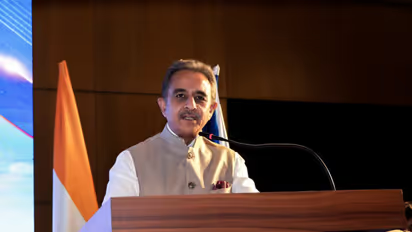
Addressing the panel “Arctic & Climate Change: Perspectives from Observers” at the Arctic Circle Assembly 2026 on October 8, Singh said, “For India, engagement with the Arctic begins with a simple recognition: geography does not define the limits of climate systems. The Arctic may be distant from India, but changes there have implications far beyond the polar region.”
In his opening remarks, shared by the MEA, Singh said India's Arctic Policy, adopted in 2022, placed science, research and international cooperation at its centre. “The Indian monsoon is shaped by a complex interaction of oceans, atmosphere, land, snow and ice. Scientists are examining how changes in the Arctic may interact with atmospheric circulation across Eurasia and influence the monsoon,” he said. “We do not yet have all the answers. But for India, understanding these connections matters. The monsoon has a direct bearing on our agriculture, water resources, energy and the livelihoods of hundreds of millions of people. This is why sustained observation, long-term research and reliable scientific data are so important,” Singh added.
India's Arctic Engagement
Highlighting India's scientific engagement with the Arctic, he said the country's research journey began in 2007, followed by the establishment of the Himadri research station at Ny-Alesund in 2008. India became an Observer in the Arctic Council in 2013 and deployed its underwater observatory in 2014. Indian scientists have also undertaken winter expeditions at Himadri since December 2023.
Connecting Arctic and Himalayan Research
Singh said India's engagement with the cryosphere extended beyond the Arctic to the Himalayas, which, despite having a different environment, formed an important component of the global cryosphere. “While changes in the Arctic sea ice, permafrost and glaciers have wider implications for the global climate system, the glacial retreat and snow depletion in the Himalayas affect ecosystems and the downstream water availability, communities and infrastructure,” he said.
“For India, this makes it important to study these systems as part of a connected Earth system. India maintains a dedicated research station – Himansh – in the Himalayas along with the Himadri Research Station in the Arctic, and our two research stations – Maitri and Bharati in Antarctica,” he added.
Incorporating Indigenous Knowledge
Emphasising the importance of incorporating local knowledge into climate research, Singh said, “Arctic Indigenous Peoples possess knowledge accumulated through generations of living in and adapting to a changing environment. Communities in the Himalaya similarly possess deep knowledge of mountains, snow, water and natural hazards.”
“There is value in bringing scientific and traditional knowledge into greater dialogue, while respecting their distinct contexts and knowledge systems,” he added.
Implications for Global Trade and Connectivity
On the implications of changing Arctic conditions for transportation and connectivity, Singh said, “As sea-ice conditions change, new maritime routes and new possibilities for shipping and infrastructure are emerging, which also pose new risks. These developments matter not only for the Arctic itself, but for wider patterns of global trade.”
He said India sought to understand these developments responsibly, in accordance with international law and with due regard for the Arctic environment and its communities. “India attaches great importance to the established international legal framework applicable to the Arctic, including the United Nations Convention on the Law of the Sea, as well as to the work of the Arctic Council,” Singh said.
He added that India's approach as an Observer was to contribute where it had expertise, learn from the experience of others and strengthen cooperation through knowledge, while recognising the particular role of Arctic States and Indigenous Peoples.
A Call for Trilateral Cooperation
Calling for greater scientific collaboration among India, Japan and South Korea, Singh said scientists from the three countries already worked alongside one another in the Arctic and urged them to build on this foundation. “Can we deepen these connections? Can we undertake joint expeditions? Can we share research facilities, observations and scientific data more systematically? Can we develop comparable research methodologies between the Arctic and the Himalaya? Can we create greater opportunities for young scientists to work in each other's institutions?” he asked.
“And lastly, can we use the next International Polar Year in 2032-33 as a horizon towards which we build sustained cooperation?” he added.
Capacity-Building and Educational Exchange
Singh also called for greater capacity-building through educational exchanges and digital learning initiatives. “Capacity-building must also be an important part of this effort. India has sought to expand access to learning through digital platforms, including Massive Open Online Courses and other online programmes. There is scope for greater exchange of educational resources, training material and expertise in polar and cryospheric sciences,” he said.
Practical Benefits of Scientific Cooperation
He highlighted the Decade of Action for Cryospheric Sciences, 2025-2034, endorsed by the United Nations General Assembly, as an important framework for advancing cooperation. “We should use these opportunities to pursue practical outcomes which could be stronger observation networks; better interoperability and sharing of scientific data; deeper Arctic-Himalaya research; greater access to scientific infrastructure and expertise; and forging enduring partnerships among the next generation of polar scientists,” Singh said.
Underscoring the practical benefits of scientific cooperation, he said, “Ultimately, the value of scientific cooperation lies in its ability to improve understanding and informed decision-making. Better glacier monitoring can strengthen early-warning systems. Better understanding of permafrost can inform infrastructure planning. Better knowledge of Arctic-monsoon linkages can contribute to climate research and preparedness. The pathway is, therefore, clear: observation, understanding and application.”
India's Constructive Role as an Observer
Summing up India's approach, Singh said, “This is the approach India brings to the Arctic. We are geographically distant, but scientifically connected. We are an Observer, but we seek to be an active and constructive one. We see the Arctic not as an isolated region, but as an important part of the Earth system that we are all seeking to understand better.”
He said India's Arctic Policy, the Decade of Action for Cryospheric Sciences and the next International Polar Year provided important frameworks and milestones for cooperation. “The opportunity before us is to turn these frameworks into practical partnerships that produce better science, stronger capacity and knowledge that can ultimately serve communities far beyond the Arctic,” Singh added. (ANI)
(Except for the headline, this story has not been edited by Asianetnews Editorial staff and is published from a syndicated feed.)