India's response to protests a model, says UN rights chief Türk
Synopsis
UN rights chief Volker Türk has lauded India's handling of student protests, citing dialogue with youth leaders as a model for governments. Speaking at the UN Human Rights Council, he contrasted India's approach with repression in other nations.
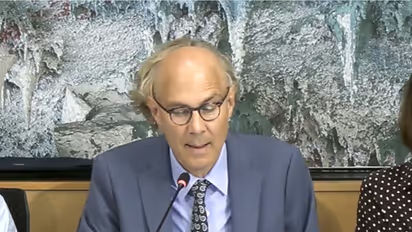
UN High Commissioner for Human Rights Volker Türk has praised India’s response to recent student-led protests in New Delhi, saying dialogue with young leaders was a far more effective approach than the excessive use of force.
Addressing the 63rd session of the UN Human Rights Council in Geneva on Monday, September 7, Türk highlighted India as an example of how governments should respond to public protests and youth-led movements.
“The recent protests in India showed the best response is dialogue with youth leaders, not the excessive use of force,” Türk said. His remarks came during a wider address on shrinking civic space, peaceful protests and human rights across the world. Türk said the rights to peaceful protest, freedom of expression and access to information were essential in building trust between governments and their citizens.
UN Chief Contrasts India's Approach With Global Repression
In contrast to India’s dialogue-based approach, the UN rights chief expressed concern over the use of repression in several countries. He said authorities in Pakistan had used “excessive lethal force and arbitrary detention” to quell protests.
Türk also raised serious concerns over China, saying he remained deeply troubled by the human rights situation in the Xinjiang Uighur Autonomous Region, including conditions in detention facilities. He urged Chinese authorities to review national security and counter-terrorism legislation, strengthen protection for minorities and investigate allegations of human rights violations, including torture.
The UN rights chief also flagged tightening restrictions on the rights of Tibetan people in China, particularly their freedom of religion, calling for an urgent reversal of such policies.
Beyond South Asia and China, Türk criticised repression in several other countries. He accused Iranian authorities of intensifying oppression and noted a sharp rise in executions on national security-related charges. He also pointed to restrictions on opposition parties in Nicaragua, suppression of political opposition in Russia, and growing restrictions on civic space and media freedom in countries including Azerbaijan, Georgia, Tunisia and Uganda.
Dialogue Hailed as a Constructive Model
Türk's remarks placed India in sharp contrast with countries where protests and dissent have been met with force and repression, holding up engagement with young protesters and dialogue as a constructive model for governments facing public discontent.
The High Commissioner stressed that peaceful protest and civic participation should serve as a bridge between public frustration and dialogue, and between people's aspirations and meaningful change. The 63rd session of the Human Rights Council is being held in Geneva from September 7 to October 7, 2026. (ANI)
(Except for the headline, this story has not been edited by Asianet Newsable English staff and is published from a syndicated feed.)