India, Nepal join forces to rescue flooded Chilime tunnel operations
Synopsis
An Indian tunnel rescue team is working with the Nepal Army to drain the flooded Chilime tunnel in Rasuwa after severe landslides. The joint mission includes technical aid, building access tracks, and a health camp for the local community.
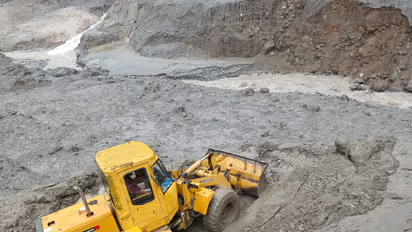
In a major push to advance operations at Nepal's Chilime tunnel, the Indian tunnel rescue team worked in close coordination with the Nepal Army to drain accumulated water and dig deeper into the shaft, following severe flooding and landslides that swept through Rasuwa district in Nepal.
The joint effort underscored active cross-border disaster response and technical collaboration between Indian specialists and Nepalese defence forces.
Joint Rescue and Aid Operations
Sharing the details in a post on X, the Indian Ambassador to Nepal, Naveen Srivastava, highlighted India's commitment to supporting Nepal through both technical expertise on-site and humanitarian aid for surrounding communities.
Specialist personnel successfully drained water logged inside the subterranean passages, allowing workers to dig deeper and secure vulnerable sections of the Chilime tunnel.
Engineering teams are constructing a temporary access track to facilitate the movement of heavy machinery and high-capacity equipment directly to the tunnel mouth.
Alongside technical operations, medical officers accompanying the Indian delegation organised a medical health camp for residents in the local community, offering health check-ups and essential supplies.
“The Indian tunnel rescue team, working alongside the Nepali Army, dug deeper into the Chilime tunnel yesterday, draining out water. A temporary track is also being made to allow more heavy equipment to reach tunnel, and doctors with the team held a health camp for the local community,” the Ambassador said.
The Indian tunnel rescue team working alongside with Nepali Army dug deeper into Chilime tunnel yesterday draining out water. A temporary track is also being made to allow more heavy equipment to reach tunnel; and doctors with the team held a health camp for the local community.… pic.twitter.com/gwZHbMLvD5 — Naveen Srivastava, Ambassador of India in Nepal (@navsri6619) September 5, 2026
Widespread Devastation and Recovery Efforts
Meanwhile, residents face immense loss as emergency recovery efforts take root.
Whole structures were swept away during the surge, leaving critical infrastructure crippled and a substantial number of community members unaccounted for.
Detailing the extent of the damage and immediate relief work on the ground, local resident Ram Ghale highlighted both the devastation and the community's swift drive toward essential recovery.
"Electricity is being restored for schools, hospitals and the village on priority. Everything was washed away. A large number of people are still missing... Four school buildings were wiped out. Electricity will be restored by the day after tomorrow; we are putting up wires today," said Ram Ghale, a local resident.
Restoring Power and Infrastructure
Efforts are underway to bring the situation back to normalcy after the devastating Bhote Koshi floods, which impacted scores of people.
Flash floods obliterated educational facilities, destroying four school buildings and levelling entire sections of the village.
Days after the devastating flash floods that left more than 1300 dead, efforts to restore electricity are underway in Betrawati, Rasuwa.
Power supply in Betrawati remains disrupted, affecting houses, schools, hospitals and other essential services.
The local administration and electricity workers are working on a war footing to restore connectivity as quickly as possible.
From erecting new electric poles to repairing damaged transmission lines and restoring other infrastructure, work is being carried out at a rapid pace.
Local villagers are also participating in these efforts.
Public Health Concerns Emerge
The aftermath of the devastating floods has affected several aspects of life in Nepal, with authorities also grappling with concerns over the contamination of drinking water sources and the possible spread of communicable diseases in flood-hit areas.
The Kathmandu Post reported on Friday that five of the 15 drinking water sources in flood-hit Bidur were found to be contaminated with E. coli.
Officials are now considering cholera vaccination for around 1,00,000 vulnerable people and measles vaccination for more than 75,000 children.
Bidur is among the areas worst affected by the Bhote Koshi floods.
Beyond the casualties, the floods swept away entire settlements and damaged or destroyed vital infrastructure, including roads, bridges and drinking water systems.
The Nepalese outlet reported that public health experts have warned that the risk of communicable, non-communicable and vector-borne diseases could increase in the aftermath of the disaster. They have advised authorities to step up preventive and relief measures, with particular attention to young children, elderly people and those living with non-communicable diseases.
Government Announces Financial Support
As relief and rehabilitation efforts continue, the Government of Nepal has announced immediate cash support for affected areas. The National Disaster Risk Reduction and Management Authority (NDRRMA) stated that NPR 10 million each has been allocated to Rasuwa and Nuwakot, NPR 5 million to Dhading, and NPR 135 million has been distributed among 15 affected local governments. (ANI)
(Except for the headline, this story has not been edited by Asianetnews Editorial staff and is published from a syndicated feed.)