India-Japan deepen ties with bullet train, mobility partnership
Synopsis
Japan has reaffirmed its commitment to help India commence commercial operations of the Mumbai-Ahmedabad High Speed Rail project by 2027. PM Modi also invited Japanese firms to participate in India's future high-speed rail corridors.
High-Speed Rail at the Core of Bilateral Talks
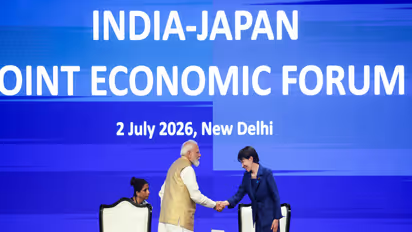
According to the joint statement by the Ministry of External Affairs after the bilateral talks between Prime Minister Narendra Modi and his Japanese counterpart Sanae Takaichi in New Delhi, the flagship bullet train project anchors a comprehensive joint agreement between the two leaders, who acknowledged the milestone goal of introducing E10 trains to the network.
Looking to the future, Prime Minister Narendra Modi explicitly invited Japanese companies to explore opportunities to participate in future high-speed corridors to help realise India's sweeping vision of a 7,000-kilometre national high-speed rail network. This transit alignment was formalised through the signing of a Memorandum of Cooperation on the Next-Generation Mobility Partnership, aimed at combining Japan's advanced mobility technologies with India's market potential and human resources.
The Mumbai-Ahmedabad High-Speed Rail (MAHSR) Project represents a major milestone in India's railway modernisation efforts. As the country's first high-speed rail corridor, it seeks to transform inter-city mobility and strengthen domestic railway capabilities. The MAHSR Project is being developed using Japanese Shinkansen technology and operational standards. The corridor incorporates advanced systems for traction, electrification, track infrastructure, and operations.
Strategic Partnership and Regional Development
The joint statement added that beyond rail infrastructure, the two leaders prioritised regional geopolitics by highlighting the strategic importance of India's North Eastern Region (NER) to realise a resilient Indo-Pacific under the Act East Policy. Japan pledged robust support for road networks, bridges, and disaster risk reduction in the NER, while both nations committed to developing industrial value chains connecting the region with the Bay of Bengal and BIMSTEC partners.
The socio-economic partnership is further backed by steady progress on four major Japanese development assistance projects: Mumbai Metro Line 11, Bengaluru Metro Phase 3, healthcare and education infrastructure in Maharashtra, and sustainable horticulture in Punjab.
Fostering Cultural and People-to-People Exchange
To anchor these economic and infrastructure pacts, the two nations are expanding people-to-people exchanges and talent circulation to address domestic challenges on both sides. The prime ministers welcomed the fact that visitors between the two countries crossed 540,000 in 2025 and reiterated their commitment to promote two-way tourism, alongside expanding dialogue on consular affairs. They also affirmed the further promotion of Japanese language education in India through the Nihongo Partners programme and highlighted the important role played by creative industries, such as anime, manga, gaming, and films, in deepening cultural connections among the youth, the statement added.
Sub-National Diplomacy Bolsters Ties
Furthermore, sub-national diplomacy is being heavily utilised to solidify these ties. The two prime ministers acknowledged the critical role played by Indian states and Japanese prefectures and municipalities in building local economic networks. They welcomed the establishment of the India-Japan Governors' Network for Friendship and Exchange, noting active high-level collaborations between regional pairings such as Yamanashi Prefecture and Uttar Pradesh, Toyama Prefecture and Andhra Pradesh, Shizuoka Prefecture and Gujarat, Hamamatsu City and Ahmedabad, Wakayama Prefecture and Maharashtra, San'in Region and Kerala, Ehime Prefecture and Tamil Nadu, and Fukuoka Prefecture and Delhi, as well as Kitakyushu City and Telangana. (ANI)