Modi, Takaichi vow to fast-track Quad summit for regional stability
Synopsis
PMs Narendra Modi and Sanae Takaichi reaffirmed their commitment to the Quad for a stable Indo-Pacific, announcing a new trilateral dialogue with the Philippines, and deeper cooperation on critical minerals and energy security, including strategic reserves.
In a major push toward regional stability, the Prime Ministers of India and Japan, Narendra Modi and Sanae Takaichi, have strongly reaffirmed their commitment to the Quad framework, prioritising a resilient and prosperous Indo-Pacific while announcing plans to fast-track the upcoming Quad Leaders' Summit
According to a joint statement released by the Ministry of External Affairs, following high-level bilateral talks, both leaders underscored that growing bilateral cooperation between New Delhi and Tokyo will directly strengthen and complement broader Quad efforts. They pledged to deepen practical cooperation across the four foundational pillars of the alliance: maritime and transnational security, economic prosperity (including critical minerals), critical and emerging technologies, and humanitarian response.
Expanding Regional Alliances
Reiterating their unwavering support for ASEAN centrality and unity, the leaders explicitly backed the ASEAN Outlook on the Indo-Pacific to promote regional peace. In a significant diplomatic expansion of these networks, the two prime ministers concurred on initiating preparations to hold an inaugural trilateral 1.5 track policy dialogue with the Philippines to promote stability in the region
Securing Critical Mineral and Energy Supply Chains
Recognising the vulnerabilities of modern technology manufacturing, the joint statement also placed heavy emphasis on securing critical mineral supply chains among like-minded countries. The leaders pledged to tighten cooperation through global financial mechanisms to prevent reliance on single-source suppliers. Specifically, the two nations will leverage major multilateral initiatives, including the World Bank Group's Resilient and Inclusive Supply-chain Enhancement Partnership and the Asian Development Bank's Critical Minerals-to-Manufacturing Financing Partnership Facility, to build robust and diversified infrastructure across Asia.
Enhancing Energy Resilience
To further fortify energy architecture across the Indo-Pacific, the two prime ministers agreed to explore collaborative opportunities, including joint investments, across the maritime energy transport value chain. They highlighted the importance of regional initiatives to strengthen energy resilience, such as Japan's Partnership On Wide Energy and Resources Resilience, India's support to energy security in South Asia, and the Quad Initiative on Indo-Pacific Energy Security, while welcoming the formal adoption of a Joint Statement on Energy Resilience.
Furthermore, they concurred on strengthening cooperation on strategic petroleum reserves, pledging closer technical collaboration and an exchange of best practices regarding the strategic stockpiling ecosystem. Against this backdrop of growing energy alignment, the Japanese Prime Minister affirmed support for India's full membership to the International Energy Agency.
16th India-Japan Annual Summit
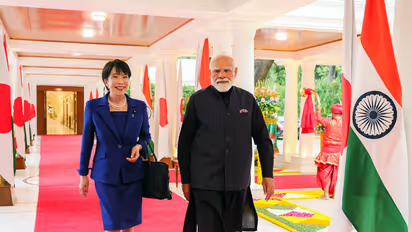
This comes as part of Takaichi's three-day official visit to India from July 1 to July 3 at the invitation of Prime Minister Modi, during which she participated in the 16th India-Japan Annual Summit, where both leaders reviewed the full spectrum of bilateral cooperation and discussed regional and global issues of mutual interest. Takaichi also took part in the India-Japan Business Forum alongside PM Modi. (ANI)