India 'closely monitoring' West Asia as Trump pauses strikes on Iran
Synopsis
India's MEA is closely monitoring West Asia after US President Trump paused military strikes on Iran for five days. The move follows 'productive conversations' between the US and Iran to de-escalate tensions in the conflict-ridden region.
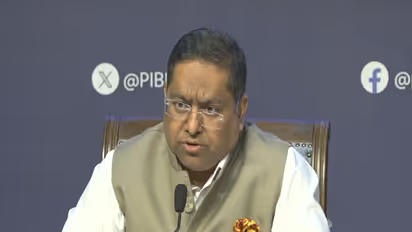
The Ministry of External Affairs (MEA) on Monday said it is 'closely monitoring' the evolving situation in West Asia after US President Donald Trump announced a pause to the US military strikes on Iran's energy infrastructure for five days.
Addressing an inter-ministerial briefing on the recent development in West Asia here, MEA spokesperson Randhir Jaiswal said that the ministry is focusing on such activities as the situation evolves amid the conflict. "We are closely following the developments--as we always do. We are keeping a focused watch on all these activities," Jaiswal said.
US Pauses Strikes Amid Diplomatic Talks
The remarks came after Trump announced that he had instructed the US Department of War to delay any military action against Iranian power plants and energy sites for five days, citing ongoing diplomatic engagements with Tehran amid escalating tensions in West Asia.
In a post on Truth Social, Trump said the United States and Iran had held "very good and productive conversations" over the past two days aimed at resolving hostilities in the region. He added that the decision to pause strikes was based on the "tenor and tone" of the discussions, which he described as "in-depth, detailed, and constructive". Trump further stated that the conversations will continue through the week.
"I am please to report that the United States of America, and the country of Iran, have had, over the last two days, very good and productive conversations regarding a complete and total resolution of our hostilities in the Middle East," the post read. "Based on the tenor and tone of these in depth, detailed, and constructive conversations, witch will continue throughout the week, I have instructed the Department of War to postpone any and all military strikes against Iranian power plants and energy Infrastructure for a five day period, subject to the success of the ongoing meetings and discussions. Thank you for your attention to this matter!" it added.
Shift From Earlier Ultimatum
The announcement came as the war between Israel, the US, and Iran had entered its fourth week. The move marks a shift from Trump's earlier stance, in which he had issued a 48-hour ultimatum to Iran to reopen the strategically significant Strait of Hormuz, warning of severe consequences if the demand was not met.
In an earlier post on Truth Social, Trump stated that if Iran does not "fully open" the Strait within 48 hours, the United States would target and "obliterate" Iranian power plants. "If Iran doesn't FULLY OPEN, WITHOUT THREAT, the Strait of Hormuz, within 48 HOURS from this exact point in time, the United States of America will hit and obliterate their various POWER PLANTS, STARTING WITH THE BIGGEST ONE FIRST!" the post read.
Iran Issues Stern Warnings
Following this, Iran on Sunday issued a stringent warning to the United States, threatening to target critical energy infrastructure across the region in an "irreversible manner". In a post on X, the speaker of Iran's Parliament, Mohammad Bagher Ghalibaf, stated that any attack on Iranian power plants or infrastructure would prompt retaliatory strikes on regional energy facilities.
"Immediately after the power plants and infrastructure in our country are targeted, the critical infrastructure, energy infrastructure, and oil facilities throughout the region will be considered legitimate targets and will be destroyed in an irreversible manner, and the price of oil will remain high for a long time," Ghalibaf stated in his post.
Ebrahim Zolfaghari, spokesperson for Iran's Khatam al-Anbiya Central Headquarters, further warned that "all power plants, energy infrastructure, and information technology (ICT) infrastructure of the Zionist regime will be extensively targeted" and added that "the power plants of countries in the region that host American bases will be legitimate targets for us," as reported by Iranian State Media, Press TV. Zolfaghari also stated that companies in the region with American shareholders could be completely destroyed, highlighting Tehran's readiness to respond to perceived threats.
"We have said repeatedly that the Strait of Hormuz is closed only to the enemy and to harmful traffic, and it has not yet been fully closed. It remains under our intelligent control, and harmless passage occurs under specific regulations that ensure our security and interests," he added, as quoted by Press TV.
Conflict Origin and Regional Impact
The development comes amid the escalating conflict that began on February 28 with the killing of 86-year-old Iran's Supreme Leader, Ayatollah Ali Khamenei, in joint military strikes by the US and Israel, after which Iran, in retaliation, targeted Israel and US assets in several Gulf countries, causing disruption in the waterways and affecting international energy markets and global economic stability. Due to the conflict in the region, Iran has virtually closed the Strait of Hormuz. (ANI)
(Except for the headline, this story has not been edited by Asianet Newsable English staff and is published from a syndicated feed.)