How Is The US-China AI Race Changing Global Power Politics, And Where Does India Fit In?
Synopsis
A high-stakes meeting between the leaders of the United States and China is bringing artificial intelligence to the center of global geopolitics, with implications that could extend far beyond the two countries.
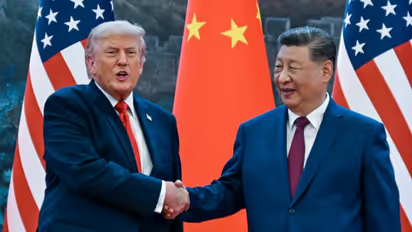
Artificial intelligence is set to become a major focus of discussions between US President Donald Trump and Chinese President Xi Jinping as the two leaders prepare for talks in Washington, underscoring how AI has become a central issue in global power politics.
The meeting comes shortly after Xi used the BRICS summit in New Delhi to promote China’s vision for international cooperation on artificial intelligence. In that setting, China emphasized broader access to AI technologies, international collaboration and support for developing nations seeking affordable technological capabilities.
The Washington discussions, however, are expected to concentrate on a different set of concerns. Rather than access and development, the agenda is likely to focus on the security risks posed by increasingly powerful AI systems and the need to prevent dangerous misunderstandings, accidents and misuse.
The contrast reflects the dual nature of the AI debate currently unfolding worldwide.
On one side are questions about expanding access to artificial intelligence and ensuring developing countries benefit from technological advances. On the other are concerns about strategic competition, military applications and the geopolitical consequences of increasingly capable AI models.
Although international forums often present AI as a multipolar issue, the technology's most advanced capabilities remain concentrated primarily in the United States and China.
As a result, decisions made in Washington and Beijing are likely to have consequences far beyond the two countries themselves.
The latest engagement between the two powers also suggests that artificial intelligence is moving closer to the center of broader diplomatic and security discussions, alongside trade, tariffs, export controls, semiconductor access and advanced computing infrastructure.
AI Competition And Cooperation Are Developing Side By Side
The current dialogue did not emerge overnight.
The United States and China have been discussing AI-related issues for roughly three years, and previous meetings have already produced limited areas of agreement.
One of the most notable developments came when both sides supported the principle that decisions involving nuclear weapons should remain under human control rather than being delegated to artificial intelligence systems.
While relatively narrow in scope, the agreement demonstrated that both countries recognize the potential risks associated with increasingly powerful technologies.
Under the Trump administration, however, AI discussions have become more closely connected to wider technological competition.
Artificial intelligence, semiconductor manufacturing, advanced chips, computing capacity, rare-earth minerals and national security have increasingly become part of the same conversation.
Recent discussions reportedly explored the possibility of creating mechanisms to manage risks associated with AI systems that could affect national security.
Such arrangements could eventually function as crisis-management tools, helping governments establish facts and communicate during incidents involving advanced technologies.
At the same time, significant differences remain.
The United States has generally focused on reducing the risks posed by powerful frontier models and their potential military uses. China has expressed concerns that safety-related discussions could be used to justify restrictions on access to advanced technologies and computing resources.
The two countries also continue to differ on issues including open-source models, data governance, regulation and export controls.
Because of those disagreements, analysts do not expect a broad AI agreement to emerge immediately.
Instead, discussions are likely to focus on narrower issues related to strategic stability and risk management.

India Faces New Questions In The AI Era
For India, the growing AI engagement between Washington and Beijing presents both opportunities and challenges.
New Delhi has consistently emphasized making artificial intelligence more useful for developing societies and expanding access to technological benefits.
However, China currently possesses deeper strengths across several critical areas, including computing infrastructure, hardware, advanced models and industrial-scale deployment capabilities.
At the same time, India remains closely linked to the American technology ecosystem and continues building partnerships through initiatives focused on technology supply chains and innovation.
These dynamics place India in a complex position.
While supporting wider international cooperation on AI, policymakers must also consider how future rules developed by major powers could affect emerging technological nations.
Concerns may arise if strategic dialogues between the United States and China begin shaping standards or controls with global implications.
Ultimately, India's long-term position in the AI landscape will depend less on diplomatic statements and more on concrete capabilities.
Computing power, semiconductor manufacturing, research capacity, access to capital, talent development and advanced AI models will determine how effectively the country participates in the next phase of technological competition.
As Washington and Beijing deepen discussions on artificial intelligence, India and other emerging powers are likely to watch closely. The outcome will not only influence the future of technology governance but may also help define the balance of power in the decades ahea