The Last Revolution? How Iran’s Faltering Resistance Mirrors China’s Shift From Mao To Deng Xiaoping
Synopsis
Iran reels from the collapse of its regional allies and a bruising war with Israel and America, sparking fierce internal debate over nationalism, nuclear ambitions, and the country’s uncertain future as its leadership faces mounting pressure.
Iran is confronting a moment of profound uncertainty after the collapse of its Lebanese and Syrian allies in late 2024 and a bruising 12‑day war with Israel and the United States this past summer. The setbacks have stripped away much of its regional influence and left the Islamic Republic grappling with questions about its future direction.
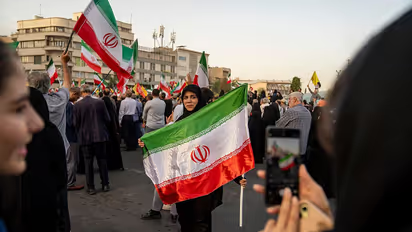
Washington has demanded that Tehran abandon its nuclear programme and contentious regional policies. Iran’s leaders reject the notion of defeat, but the war has shaken the country and triggered a reckoning at home. Nationalism has surged as the ruling order seeks refuge in symbols of ancient kings and heroes. Public squares in Tehran now display statues celebrating Iran’s pre‑Islamic past, while social changes have accelerated.
Women appear without hijabs, mingle freely in cafés, and even ride motorcycles, altering the face of the capital. The government appears to have relinquished its ideological grip and shows little sign of reclaiming it.
Against this backdrop, preparations for another conflict dominate the leadership’s agenda. Supreme Leader Ayatollah Ali Khamenei continues to frame Iran’s national interest around resistance to America, a strategy that has long defined the country’s policies but now faces growing scrutiny. His authority remains intact, yet his approach has lost credibility. Figures across the political spectrum, including former president Hassan Rouhani, are openly questioning whether continued defiance is sustainable.
Until recently, Iran had avoided direct war with Israel and America by relying on proxies such as Hamas, Hizbullah, and militias in Iraq, Syria, and Yemen. The Gaza war changed that calculus. Israel’s strikes crippled Hizbullah, while the Assad regime in Syria collapsed, leaving Iran exposed. Many Iranians now ask why those defenses crumbled so quickly and why Hizbullah failed to unleash its promised firepower despite years of investment.
The 12‑day war intensified scrutiny. Israeli‑American attacks caught Iran off‑guard. Though its nuclear programme survived and missile barrages inflicted damage on Israel, the sense of vulnerability was acute. Survival was cast as victory, but ordinary Iranians were rattled by the scale of the threat.
Khamenei had once believed Iran could avoid war while rejecting diplomacy after America withdrew from the 2015 nuclear deal. That ambiguity collapsed when Iran lost its regional buffers. Washington abandoned negotiations in favor of military action, leaving Tehran scrambling for a new strategy.
Iran’s leadership now seeks to entice America back into dealmaking, believing it still holds leverage through its nuclear programme and stockpile of enriched uranium. Yet divisions run deep over how far to go. Some argue Iran must abandon its long‑standing doctrine and secretly pursue nuclear weapons, following the path of India, Israel, North Korea, and Pakistan.
Hassan Khomeini, grandson of the republic’s founder, has voiced support for this approach, insisting only nuclear arms can guarantee deterrence. Senior clerics in Qom have urged Khamenei to revoke his fatwa against nuclear weapons. Many ordinary Iranians, fearful of another war and humiliated by recent defeats, also favor this course.
Others warn that pursuing a bomb would only deepen isolation and invite further conflict. They argue Iran should instead accept drastic cuts to its programme in exchange for economic relief. Prosperity, they contend, cannot coexist with nuclear brinkmanship. President Masoud Pezeshkian’s warning that Tehran may become uninhabitable due to water shortages highlights the urgency of prioritizing domestic needs over military ambitions.
For decades, resistance defined the Islamic Republic’s identity. That narrative has faltered, and Iranians are debating the consequences. The revolution that reshaped the region in the late 20th century is entering a new chapter, perhaps its final one. Comparisons are being drawn to China’s transition from Mao to Deng Xiaoping. Iran’s rulers weigh their options, but the people appear ready for their own Deng.