What Is Pakistan Hiding About Gwadar Naval Base? The Cost, Debt and China Questions Remain Unanswered
Synopsis
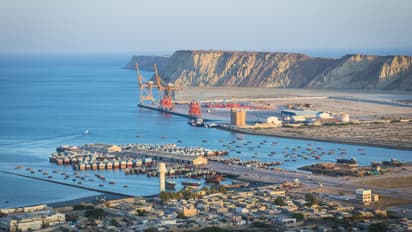
Pakistan’s planned Gwadar Naval Base is emerging as a massive strategic project spanning 69 acres, multiple construction phases, warship berths, submarine facilities, and specialised workshops. However, its total cost, financing structure, loan terms, contractors, and procurement details remain undisclosed.
The scale of the Gwadar Naval Base project is becoming clearer — 69 acres of reclaimed coastal land, three phases of construction, sixteen to twenty warships, two submarine pens, a graving dock, and thirty specialised workshops. What remains entirely hidden is the number that matters most: what it will cost, who is paying for it, and on what terms.
Every rupee that Pakistan borrows has a cost: an interest rate, a repayment schedule, and a set of conditions that may constrain future policy choices. Every contract Pakistan signs has terms: procurement standards, performance requirements, dispute resolution mechanisms, and in the case of contracts with Chinese state firms, sometimes provisions that are considerably more complex and consequential than their surface descriptions suggest.
The Gwadar Naval Base Project
The Gwadar Naval Base involves both borrowing and contracting at a scale that should command intense public and parliamentary scrutiny. Instead, it has been advanced with a degree of fiscal transparency that approaches zero.
No official source has publicly confirmed the total cost of the project. The three-phase structure, a common approach in CPEC's portfolio, and one that is well understood to obscure total liability by revealing it one instalment at a time, means that even if individual phase costs were disclosed (which they have not been), the full financial commitment would not be visible at any single moment.
The contractors shortlisted for the project have not been named in any public tender process. The financial terms on which construction will proceed, whether Pakistani government funds, Chinese state loans, or some combination, have not been announced. The interest rates, if loans are involved, have not been disclosed. The equity arrangements, if any, are unknown.
Transparency International's Government Defence Integrity Index has placed Pakistan in one of the highest-risk categories globally for corruption in the defence sector, with financial management identified as the most acute vulnerability area. The Gwadar Naval Base is proceeding in conditions that perfectly match that assessment.
This pattern of fiscal opacity is not a novelty in the CPEC context, it is a feature. A series of government audits and investigative reports over recent years have documented how the terms of CPEC power and infrastructure projects were concealed from Pakistan's parliament, the public, and, in some cases, from civilian ministries for years after agreements were signed.
When the Imran Khan government commissioned a nine-member audit committee to examine the power sector in 2020, the resulting 278-page report documented how government-to-government deals signed under CPEC had been structured to favour Chinese investors: capacity payments guaranteed regardless of actual power consumed, dollar-denominated returns set above market rates, and terms that a previous government's own commerce adviser described publicly as having been negotiated without adequate preparation.
By June 2025, outstanding payments to Chinese power producers had swollen to PKR 423 billion — more than a hundred billion of which consisted of accumulated late payment penalties rather than the underlying energy costs.
Pakistan’s Auditor General 2023-24 defence services audit separately identified over 300 pages of procurement irregularities across defence formations, including procurements made in violation of relevant rules and advance payments without proper documentation.
The institutional architecture for fiscal accountability exists. Its exercise, in both the CPEC and defence contexts, has been conspicuously incomplete.
The naval base raises the stakes of this opacity considerably. Unlike a power plant or a highway, a naval base is a sovereign military installation whose financing terms may carry implications for operational autonomy that go well beyond the fiscal. If the base is financed through Chinese state loans with conditions — explicit or implicit — that give China leverage over the terms of PLA(N) access, then the financing structure is not merely a fiscal matter. It is a question of whether Pakistan is mortgaging its military infrastructure to the power whose naval forces the base is explicitly designed to service.
The answer to that question is currently unknown because the question has not been answered publicly. That silence should not be mistaken for assurance.
The remedy is neither novel nor technically demanding. Pakistani fiscal reformers, the IMF in successive programme negotiations, and parliamentary oversight bodies have all articulated it in the broader CPEC context: full public disclosure of all financing agreements before construction proceeds, independent cost auditing by bodies with no stake in the project, transparent competitive tendering for construction contracts, and parliamentary authorisation for debt obligations above a defined threshold.
These are not extraordinary requirements. They are the baseline expectations of responsible public financial management — the floor, not the ceiling, of accountability. The Gwadar Naval Base provides the Pakistani government with a clear opportunity to demonstrate that those expectations are being met. The opportunity is, at present, being ignored. And the cost of that silence — financial and strategic — will eventually fall on the Pakistani public, whether or not they were ever told what was being built in their name.