Five Key Facts About the Escalating Thailand-Cambodia Border Crisis
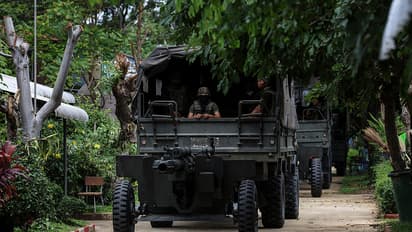
Synopsis
The Thailand-Cambodia border dispute, rooted in colonial-era mapping, has escalated into the deadliest conflict in over a decade.
Bangkok: A Thailand-Cambodia territorial row has boiled over into the two countries' deadliest conflict in more than a decade, with at least a dozen people killed in fighting.
While the Southeast Asian countries have long been at loggerheads over their shared border, tensions most recently flared at the end of May after a Cambodian soldier was killed in a border clash.
Since then, the two sides have traded barbs and tit-for-tat retaliatory measures, and triggered a political crisis in Thailand -- up until this week's dramatic escalation of force.
Here are five things to know about the border causing friction between the neighbouring nations:
- Colonial hangover -
Thailand and Cambodia's 800-kilometre-long (500-mile) border was largely drawn during the French occupation of Indochina between 1863 and the mid-1950s.
Thai political scientist Thitinan Pongsudhirak has said the mapping agreed between the French and the Kingdom of Siam -- encompassing Thailand's current territory -- remains the "crux of the problem" today.
In World War II, Siam gained certain Cambodian territories but was forced to hand them back to French rule in 1946.
The 1979 overthrow of Cambodia's communist Khmer Rouge regime blurred the boundaries further as its last members fled to the border region for refuge.
Dozens of kilometres remain contested and in 2008 military clashes erupted over a patch of land next to the 900-year-old, UNESCO-recognised Preah Vihear temple, located on the border.
Sporadic violence from 2008 to 2011 led to the deaths of at least 28 people and displacement of tens of thousands.
- Fresh crisis -
The latest crisis began on May 28 when a Cambodian soldier was killed in an exchange of gunfire with the Thai army at the border, with both sides claiming they had acted in self-defence.
Restrictions were put on land border crossings and peace-seeking talks stalled.
Thai Prime Minister Paetongtarn Shinawatra was suspended from office after she was accused of appeasing Phnom Penh and undermining the Thai army in a leaked phone call with ex-Cambodian leader Hun Sen.
Five Thai military personnel were wounded in a landmine blast at the border this week, leading Thailand to downgrade its diplomatic relations with Cambodia.
Thailand launched air strikes on Cambodian military targets on Thursday as Cambodia fired rockets and artillery, leaving at least 11 civilians dead and dozens wounded, according to the Thai public health ministry.
- International adjudication -
The International Court of Justice (ICJ) granted Phnom Penh sovereignty over the Preah Vihear temple in 1962 and over a small patch of land surrounding it in 2013, but Thailand does not recognise its jurisdiction.
Cambodian Prime Minister Hun Manet said last month that his government had filed a new complaint with the UN tribunal over four disputed areas, but Thailand has pushed to seek a solution through a nearly 30-year-old bilateral mechanism.
Hun Manet on Thursday requested the UN Security Council convene an "urgent meeting" over the cross-border fire with Thailand.
The armed conflict drew concern from China, Malaysia, the United States and France, with diplomats urging Phnom Penh and Bangkok to resolve their differences through dialogue.
- Domestic dynamics -
Analysts have said the conflict reveals an uneasy mood in both nations.
Political analyst Ou Virak has said Cambodia is "desperate to stand up to what could be perceived as bullying by a bigger neighbour".
But he warned the "nationalist flame can easily be ignited and is very difficult to put out".
In Thailand, analysts say the conflict is being fanned by long-standing tensions between the Shinawatra political dynasty and the Thai army, which has staged a dozen coups and remains immensely influential in periods of democratic rule.
"The border clash is likely to get worse" as the Thai army is effectively in charge of border policy, said Thitinan.
- Diplomatic warfare -
Both sides maintain that the other attacked first.
Thailand's government spokesman accused Cambodia of being "inhumane, brutal and war-hungry" and later accused them of a "targeted attack on civilians".
Meanwhile, Cambodia's foreign ministry accused Thailand of "unprovoked military aggression" and the defence ministry said Cambodian soldiers only attacked military targets.