Explained: Why Iran Is the Only Country Still Flying the Top Gun F-14 Tomcat
Synopsis
Iran remains the only country flying the F-14 Tomcat, acquired before the 1979 revolution. After sanctions cut off US support, Tehran kept a limited fleet operational through cannibalisation, reverse engineering and indigenous manufacturing.
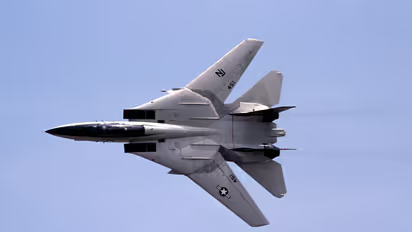
The Grumman F-14 Tomcat, an iconic Cold War–era fighter jet immortalised by Hollywood’s Top Gun, has long been retired by every air force in the world — except one. Iran remains the sole operator of the F-14, continuing to fly a platform the United States itself phased out nearly two decades ago. The reasons lie in history, geopolitics, sanctions, and sustained improvisation.
How Iran Got the F-14
In the 1970s, Iran, under Shah Mohammad Reza Pahlavi, was a close US ally. Washington sold Tehran 79 F-14 Tomcats, along with the powerful AIM-54 Phoenix long-range missiles, to counter Soviet threats in the region. At the time, Iran was the only country ever allowed to buy the F-14.
The Turning Point: 1979 Revolution
The Islamic Revolution of 1979 abruptly ended US-Iran military cooperation. Sanctions cut Iran off from spare parts, upgrades, and technical support. Overnight, Iran was left operating one of the world’s most complex fighter jets with no official supply chain.
How Iran Kept the F-14 Alive
Despite severe constraints, Iran managed to keep the Tomcat flying through multiple methods:
• Cannibalisation: Several aircraft were dismantled to keep others airworthy.
• Reverse engineering: Iranian engineers reproduced components domestically.
• Local manufacturing: Basic avionics, structural parts and subsystems were rebuilt inside Iran.
• Covert sourcing: Authorities reportedly used intermediaries and black-market routes to acquire rare components.
Role in Iran’s Air Defence
The F-14 remains valuable for its long-range radar and interception role, especially against reconnaissance aircraft and potential intrusions. While outdated in modern air combat, it still acts as a deterrence and surveillance platform within Iran’s layered air defence network.
How Many Are Still Flying?
Estimates suggest 20–25 F-14s remain, with fewer than a dozen fully operational at any given time. Many airframes are believed to be grounded or used solely for spare parts.
Why the US Destroyed Its Own F-14s
After retiring the jet in 2006, the US destroyed or dismantled its F-14 fleet. This was done specifically to prevent spare parts from reaching Iran through resale or scrap markets.
Despite this, the continued operation of the F-14 in Iran is a testament to decades of improvisation, adaptation and persistence in the face of prolonged sanctions and isolation. What was once a cutting-edge interceptor has effectively become a living relic of Cold War-era military aviation — still airborne, but increasingly outpaced by modern fighter technology.
Symbolism Over Superiority
Militarily, Iran’s F-14s are no match for modern stealth fighters like the F-35. Politically and symbolically, however, their continued operation showcases Iran’s ability to adapt under sanctions.
In essence, Iran’s F-14 fleet is less about battlefield dominance today and more about persistence, legacy, and strategic signalling -- a rare flying reminder of a bygone era in global military aviation.