Explained | India-EU FTA: Why the ‘Mother of All Deals’ Is Shaking Pakistan and Bangladesh
Synopsis
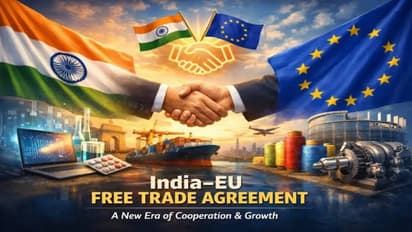
India and the EU concluded a historic Free Trade Agreement set to eliminate or reduce tariffs on a wide range of Indian goods, including textiles and apparel. This pact aims to boost India’s exports by providing enhanced access to the vast EU market.
India and the European Union have concluded what leaders are calling a historic free trade agreement (FTA) — often dubbed the “mother of all deals” — that could transform India’s role in global commerce while unsettling export-dependent economies like Pakistan and Bangladesh. After nearly two decades of negotiations, India and the EU announced the pact at a high-profile summit in New Delhi, marking a major shift in trade diplomacy and economic strategy.
At its core, the India-EU FTA aims to liberalise trade between India and the 27-nation bloc by eliminating or sharply reducing tariffs on a wide range of goods — including textiles, apparel, leather, gems and jewellery, and other labour-intensive products. The deal is expected to open up the EU’s vast market — one of the world’s largest importers — giving Indian exporters duty-free or reduced-duty access to consumer and industrial markets previously constrained by tariff barriers.
What the Deal Means for India’s Exporters
Under the agreement, the EU will phase out import duties on the majority of Indian exports, significantly improving their cost competitiveness. Indian textiles and apparel, for example, face zero-duty access on key tariff lines — removing a long-standing disadvantage compared with rivals like Bangladesh and Pakistan, which previously benefitted from preferential access under EU schemes.
India’s textile and apparel exports, already a major contributor to the country’s merchandise export basket, stand to gain immensely. Industry estimates suggest that apparel exports to the EU could double within five years, while other labour-intensive sectors such as leather goods and footwear are also expected to expand their footprint. The removal of tariffs — many of which once ranged between 9% and 12% — will allow Indian manufacturers to compete not just on price but also on quality, design and compliance.
For India’s broader manufacturing base, the agreement provides a competitive edge in sectors where exporters had struggled with tariff disadvantages. By temporarily or permanently eliminating duties on machinery, chemicals, marine products and other key goods, the pact integrates Indian products more deeply into European supply chains, making them more attractive to global buyers.
Regional Ripple Effects: Pakistan and Bangladesh Under Pressure
While the deal is being hailed in India and the EU, it has sparked concern in neighbouring economies that depend heavily on preferential access to European markets. Pakistan’s textile industry, for instance, has been built around the EU’s GSP Plus scheme, which grants duty-free entry for the bulk of its exports, particularly garments and clothing. With India’s tariff disadvantage removed, analysts warn that Pakistani exporters may lose their competitive edge, potentially risking millions of jobs in a sector that accounts for a significant share of the country’s exports.
Similarly, Bangladesh — a major beneficiary of the EU’s Everything But Arms (EBA) arrangement — could face structural challenges. While Bangladesh has enjoyed duty-free access for years, its loss of Least Developed Country (LDC) status means it will require GSP Plus or new trade arrangements to maintain competitiveness against duty-free Indian exports once the FTA takes effect. This shift could erode Bangladesh’s position in Europe’s lucrative apparel market, prompting policymakers and industry leaders to consider strategic responses.
The shifting competitive dynamics extend beyond South Asia. Countries like Turkey and Vietnam, which also hold preferential trade arrangements with Europe, will find themselves adjusting to increased Indian participation — especially in textile, leather and garment segments where price and market access are key determinants of global sourcing decisions.
Broader Implications: Global Strategy and Economic Growth
Beyond sector-specific impacts, the India-EU FTA reflects broader geopolitical and economic trends. Facing rising protectionism and tariff volatility — particularly from the United States — India has pursued diversification of trade partnerships to reduce dependency on any single market. The EU deal supports this strategy by providing Indian exporters with alternative high-value markets and integrating India into larger global value chains.
For the EU, the agreement presents an opportunity to deepen economic ties with a booming Asian economy while cushioning its own industries against broader geopolitical uncertainties. The pact will likely boost bilateral trade volumes, encourage investment flows and create channels for technology and services cooperation in sectors such as manufacturing, pharmaceuticals, IT and financial services.
However, challenges remain. The FTA still needs parliamentary ratification in the EU and domestic approval in India before implementation — a process expected to take several months. Additionally, areas such as agricultural trade, regulatory harmonisation and environmental compliance will require ongoing negotiation and adaptation to ensure mutual benefit.
Looking Ahead: Opportunities and Adjustments
As the India-EU free trade agreement moves toward implementation, stakeholders are already recalibrating strategies. Indian exporters are preparing to scale up production, upgrade quality standards and meet stringent EU market requirements. At the same time, policymakers in Pakistan, Bangladesh and other export-dependent nations are exploring ways to protect their industries through diversification, enhanced competitiveness and new trade partnerships.
Ultimately, the deal marks a watershed moment in India’s economic diplomacy — one that could reshape global trade patterns, strengthen India’s export landscape and redefine competitive dynamics across continents.