Experts at UNHRC event back India's move on Indus Waters Treaty
Synopsis
At a UNHRC side event in Geneva, international experts supported India's decision to keep the Indus Waters Treaty in abeyance, citing community water rights, security concerns, and Pakistan's conduct as justification for a review.
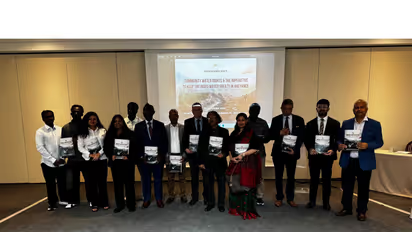
Shivi Development Society (SDS) organised a side event on the sidelines of the 63rd session of the United Nations Human Rights Council (UNHRC) in Geneva, bringing together international experts and human rights advocates to discuss community water rights and the future of the Indus Waters Treaty (IWT).
Titled “Community Water Rights and the Imperative to Keep the Indus Water Treaty in Abeyance,” the event was held on September 17, 2026, from 11:30 AM to 1:00 PM at Hotel Royal Manotel, Rue de Lausanne 41, 1201 Geneva, Switzerland. The side event focused on the evolving challenges surrounding the treaty, with particular attention to the 2025 decision to keep the treaty in abeyance, demographic pressures, climate vulnerability and increasing water scarcity within the Indus Basin. The discussions examined the implications of transboundary water governance, emerging hydropolitical tensions and the need for equitable, sustainable and climate-resilient approaches to water cooperation in South Asia.
Experts Back India's Stance on IWT
According to the press note issued after the event, international experts and human rights advocates expressed support for India’s decision to keep the Indus Waters Treaty in abeyance, arguing that the issue should be viewed in the broader context of India’s security concerns, bilateral relations and the rights of communities dependent on the Indus river system. The conference examined the IWT from the perspectives of human rights, community water rights, transboundary water governance and regional security.
Treaty's Legal and Structural Flaws Highlighted
Dr. Siegfried O. Wolf, Director of Research at the South Asia Democratic Forum, Brussels, argued that India was within its sovereign rights to seek a review of the 1960 treaty. Dr. Wolf maintained that, in his assessment, Pakistan’s conduct had undermined what he described as the object, purpose and spirit of the agreement. He also highlighted what he characterised as structural asymmetries in the treaty, including the distribution of Indus river waters, India’s financial contribution to the Indus Development Fund, limitations relating to storage and infrastructure, and repeated legal challenges concerning Indian hydropower projects.
He referred to legal challenges involving Indian hydropower projects including Baglihar, Kishenganga and Ratle. Addressing Pakistan’s concerns regarding Indian projects on the western rivers, Dr. Wolf described the assertion that India is simply “blocking” river flows as an “engineering myth.” He argued that Indian hydropower projects on these rivers are principally non-consumptive, with water subsequently released downstream.
Dr. Wolf further contended that Pakistan’s water challenges have significant domestic dimensions, pointing to agricultural patterns, landholding structures, urban pressures and ageing canal infrastructure.
Human Rights, Security, and Internal Resource Distribution
Arif Aajakia, a London-based human rights activist, emphasised that access to water is a fundamental human right. He raised concerns regarding the distribution of water resources within Pakistan, particularly in Sindh. Referring to historical tensions between India and Pakistan, including major terrorist attacks in India, Aajakia argued that India’s decision to place the IWT in abeyance was justified in light of its broader security concerns.
Mamun Rahman, a Geneva-based human rights expert from the International Forum for Secular Bangladesh, drew attention to the distribution of natural resources within Pakistan. Rahman argued that questions concerning resource and water sharing should also be examined from the perspective of communities in provinces such as Sindh and Balochistan. He called for a comprehensive discussion on transboundary water governance, emphasising that decisions relating to water have consequences for communities across borders.
In a video statement, Lakhu Luvana, Chairperson of the World Sindhi Congress, London, UK, argued that Sindh and Balochistan have faced longstanding concerns regarding the use and distribution of their natural resources, including water. He maintained that these concerns extend beyond the existence or operation of any particular bilateral treaty.
A Call to Centre Community Rights
The conference was chaired by Narender Kumar, Executive Director of Shivi Development Society, Delhi, India, who emphasised that the debate over the Indus Waters Treaty should not be confined to relations between the two states. “The question of keeping the Indus Waters Treaty in abeyance is not only about a bilateral agreement between two countries. It is also about recognizing the rights and legitimate water needs of local communities that depend on the Indus river system, including communities in India,” Kumar said.
He stressed the importance of placing human rights, equitable access to water, community participation and sustainable water governance at the centre of discussions on transboundary rivers.
The event brought together discussions on the treaty’s future with wider concerns surrounding community water rights, water scarcity, climate vulnerability, demographic pressures and transboundary water governance in the Indus Basin.
The speakers at the event were Dr. Siegfried O. Wolf, Director of Research, South Asia Democratic Forum, Brussels; Mr. Arif Aajakia, Human Rights Activist, London, UK; Mr. Biro DIAWARA, Representative of RADDHO and Interfaith International, Geneva; and Dr. Lakhu Luvana, Chairperson, World Sindhi Congress, London, UK (TBC). Narender Kumar, Executive Director of Shivi Development Society, Delhi, India, served as the moderator. (ANI)
(Except for the headline, this story has not been edited by Asianetnews Editorial staff and is published from a syndicated feed.)