Divided Washington: What America's Verdict Means for India
Synopsis
Democrats' gains in the US Congress could reshape India-US relations, offering potential relief on immigration and trade. However, disagreements over Russian oil, tariffs and India's domestic policies may complicate ties with Washington.
For the five million people of Indian origin who call the United States home, the past two years have carried a quiet, persistent anxiety. Online hostility aimed at South Asians climbed by 240 per cent between 2024 and 2026, a figure worth repeating because behind it sit real families reading real abuse on their phones each morning. Some of that hostility has flowed from the very top. Vice President JD Vance likened foreign workers to indentured servants, the bonded labourers of colonial times who were shipped abroad and tied to an employer for years, a comparison that landed as an insult to every Indian who arrived on merit. The Department of Homeland Security itself published a post urging Indian truck drivers to self-deport, captioned with a taunt that a certain "Mr Singh" could not drive and should get off American roads. No attempt was made to disguise the prejudice.
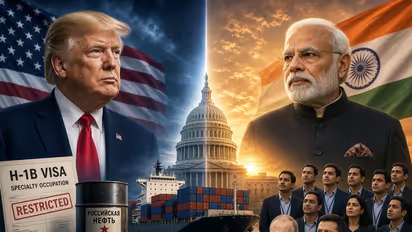
This is why the Democratic surge in the recent American election matters at a human level before it matters at a strategic one. The party fields a deep bench of Indian American leaders, many of whom have now won local and state office, placing them in charge of policing and public order in their own communities. Visas tell a harder story. The Trump administration has squeezed skilled work visas such as the H-1B, the permit on which most Indian engineers and doctors enter America, and made them markedly more expensive. New Delhi hopes the Democrats will resist, but the president still controls the immigration machinery day to day. Relief, if it arrives, will arrive slowly.
Step back and the wider picture is mixed rather than rosy. India-US relations have slid sharply over two years, largely because Donald Trump ran foreign policy at whirlwind speed, often through personal and opaque arrangements. Pakistan and the Gulf monarchies adapted to that style with ease. India, whose diplomacy rests on rules, procedures and strategic interest rather than personal favour, found it bewildering.
Here the new Congress may genuinely help. Democrats have promised to investigate the president's overseas dealings: his business ties with Qatar, Saudi money invested in his son-in-law's ventures, and Emirati capital flowing into his crypto enterprise. His engagement with Pakistan could fall under the same scrutiny. The committee in Congress that oversees foreign affairs is a formidable body, able to examine agreements, summon senior diplomats, and freeze aid and arms deals. A return to diplomacy conducted through institutions rather than private handshakes suits Delhi far better.
Yet Democrats carry habits of their own. They cast themselves as the world's moral guardians, commenting on protests and legislation in other countries, as they have on India's farm protests and citizenship law, and occasionally passing resolutions on matters purely internal to them. Delhi treats this as an irritant rather than a rupture, having weathered it many times before.
Russia is the sharper edge. Trump wants an accommodation with Vladimir Putin and is leaning on Ukraine to concede ground. Democrats stand firmly behind Kyiv and will likely push for tougher sanctions, possibly reaching Moscow's trading partners. India, a major buyer of Russian crude, could be caught in that crossfire. The warning has already been sounded: after September's sanctions bill passed, a Democratic senator bluntly told India and China to clean up their act and buy their oil and gas elsewhere.
That September law is also where tariffs turn complicated. Put simply, Congress has handed the president a loaded weapon: the power to impose 100 per cent tariffs, doubling the price of goods at the border, on any country that buys Russian oil. India, China and Turkey are squarely in frame. Democrats oppose Trump's broader tariffs and have drafted legislation to repeal them, but a presidential veto can brush such laws aside. Trump granted India a waiver last month, yet the authority to punish remains fully intact. His political hand has weakened; his legal hand is unchanged. Everything turns on what he decides.
And decisions are now shaped by bargaining. Trump is in the closing stretch of his presidency, with Congress no longer in his party's grip, which means he must trade to accomplish anything. He says he wants to work with the Democrats, and each side needs the other. One could imagine him expanding healthcare spending, a signature Democratic demand, in exchange for the party tolerating certain tariffs. Or Democrats might keep funding Immigration and Customs Enforcement while Trump softens immigration rules. These remain hypotheticals, but they are the texture of the months ahead.
Officially, the Indian government has said nothing. Privately, diplomats have told reporters that Delhi is cautiously optimistic and that trade friction may ease. Any check on an unpredictable presidency is welcome in the External Affairs Ministry. But hope is not a policy, and India has learned to brace for the gap between what an election promises and what a president eventually does.
(Girish Linganna is an award-winning science communicator and a Defence, Aerospace & Geopolitical Analyst. He is the Managing Director of ADD Engineering Components India Pvt. Ltd., a subsidia,ry of ADD Engineering GmbH, Germany.)