Behind The Hype: Pakistan's Hangor Submarine And The Risk Of An Untested Core
Synopsis
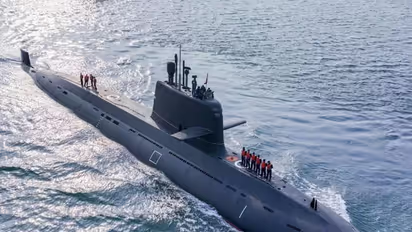
The South China Sea air was thick with ceremony on 30 April 2026. Pakistani President Asif Ali Zardari and Chief of Naval Staff Admiral Naveed Ashraf stood on Chinese soil – in Sanya's naval port – to watch PNS Hangor slide into service.
New Delhi: The South China Sea air was thick with ceremony on 30 April 2026. Pakistani President Asif Ali Zardari and Chief of Naval Staff Admiral Naveed Ashraf stood on Chinese soil – in Sanya's naval port – to watch PNS Hangor slide into service. The speeches spoke of sovereignty. Of striking power. Of eight submarines that would, Islamabad hoped, redraw the balance beneath the waves.
A strategic deterrent against India. The talking points were polished and confident. What was conspicuously absent from the occasion as it has been from every briefing before it – is any credible answer to a question that defence engineers and naval strategists keep raising: what exactly is powering these submarines, and has it been proven to work?
Three sister boats – PNS Shushuk, PNS Mangro, and PNS Ghazi – were in the final stages of sea trials by the time of the commissioning, with all four Chinese-built vessels potentially entering service within 2026 itself.
The remaining four are to be assembled locally, with full induction of the fleet expected between 2028 and 2030. Pakistani officials describe the pace as a historic expansion of the country's underwater capability. What they do not describe is the engine at the heart of it.
The original plan for the Hangor class called for MTU diesel engines, but the programme hit a major disruption when Germany refused to issue export licences for the units originally specified. The CHD620 engine had previously drawn attention during delays to Thailand's S26T submarine programme, after Germany blocked the export of MTU 396 engines to China under European Union arms restrictions.
China stepped in with the CHD620 as a substitute, and it now forms the propulsion core of the entire eight-submarine fleet. On paper, the switch looks manageable. In practice, it introduces a layer of operational uncertainty that Pakistan's defence establishment has chosen not to address publicly.
The CHD620 is a Chinese-built high-speed diesel engine traced back to designs originally licensed from Germany's MTU.
The core concern is that the Chinese engines lack the same long, well-documented operational track record as the German originals. At present, no publicly confirmed operational navy, excluding possible experimental or prototype use -- is known to have adopted the CHD620 for active submarine service. Pakistan has not publicly objected to the replacement.
To reassure Thailand's navy over the parallel S26T deal, China cited extensive bench testing reportedly over 6,000 hours and offered extended warranty terms, claiming the CHD620 meets required performance parameters.
Bench testing, however, is not the same as operational validation. Long-duration patrols, high sea-state operations, emergency sprint scenarios -- none of this has been confirmed through independent testing or documented in open-source technical literature. The engine exists in these submarines, and the world is being asked to take that on faith.
This is not a trivial concern. Engine reliability is not merely a maintenance question – it is a combat survivability question. A submarine that loses propulsion at depth, in a contested maritime environment, faces catastrophic consequences.
The Arabian Sea is not a test range, and the waters where these vessels would be expected to operate are among the most surveilled in the Indian Ocean Region, with the Indian Navy having invested heavily in its anti-submarine warfare capabilities.
One nuance that Pakistan's promotional messaging does not always obscure is the platform's Air Independent Propulsion system.
The Hangor class uses a Stirling-cycle AIP system, which allows a submarine to operate underwater without snorkelling for extended periods – potentially several weeks. This is a genuine capability, and it meaningfully complicates Indian ASW planning. But AIP does not resolve the questions around the diesel engines, which remain the primary propulsion source for surface transits and high-speed manoeuvres where the AIP system's low-speed limitations apply.
Beyond reliability, there is the question of long-term sustainment. Pakistan's ability to source spare parts, conduct deep overhauls, and train engineers who can maintain the CHD620 is substantially dependent on China.
The technology transfer arrangement at Karachi Shipyard and Engineering Works is still building the institutional knowledge required to service these vessels. The programme survived supplier disruptions, pandemic-driven delays, and a forced engine switch and these were peacetime conditions. What happens if that supply chain is disrupted during a period of strategic tension? What happens if Beijing's own production priorities shift?
Pakistan's Ministry of Defence ordered eight submarines from China in 2015, in what became the largest arms export contract in Chinese military history. A decade later, the ribbon has been cut and the first boat is in the water.
The commissioning ceremony in Sanya was everything Islamabad wanted it to be visible, symbolic, and strategically resonant. What it was not was an answer to the questions that have followed this programme since its inception.
The silence from Islamabad on engine reliability is not an oversight. It is a choice. And in matters of naval warfare, unanswered questions have a way of being answered at the worst possible moment.