What Is ‘Criticality’? India’s Fast Breeder Reactor Milestone Explained
Synopsis
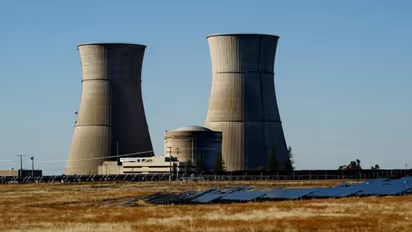
India has achieved a major nuclear milestone as its Prototype Fast Breeder Reactor (PFBR) in Kalpakkam reached criticality, initiating a self-sustaining chain reaction. This indigenously developed reactor is central to India's three-stage nuclear program, designed to generate more fuel than it consumes.
India has achieved a landmark milestone in its nuclear energy journey, with the Prototype Fast Breeder Reactor (PFBR) at Kalpakkam in Tamil Nadu attaining “criticality” — a crucial stage that marks the start of a controlled nuclear chain reaction. The development is being hailed as a major breakthrough in India’s long-term atomic energy programme and a significant step towards energy self-reliance.
Prime Minister Narendra Modi described the achievement as a “defining step” in India’s civil nuclear journey and a “proud moment for India”, praising scientists and engineers behind the project. His remarks underline the strategic importance of the reactor, which has been indigenously designed and built, showcasing India’s growing technological capabilities in advanced nuclear systems.
The PFBR is a 500 MWe sodium-cooled fast breeder reactor developed at Kalpakkam by Bharatiya Nabhikiya Vidyut Nigam Limited (BHAVINI). Unlike conventional reactors, fast breeder reactors are designed to generate more fissile material than they consume, making them highly efficient and sustainable. This unique capability is particularly important for India, which has limited uranium reserves but abundant thorium deposits.
The reactor plays a central role in India’s three-stage nuclear power programme, originally envisioned by physicist Homi J. Bhabha. In this framework, fast breeder reactors form the second stage, using plutonium-based fuel to eventually produce uranium-233 from thorium — a key resource for India’s future energy needs.
Also Read: Indian Scientists Unlock Moon's Deep Secrets Ahead Of Chandrayaan-4 Mission
Achieving criticality is a crucial step before full-scale power generation begins. It indicates that the nuclear fission process is self-sustaining, with enough neutrons produced to maintain a steady reaction. Following this milestone, the reactor will undergo further testing and calibration before becoming fully operational, which is expected later in 2026.
The PFBR is also significant from a sustainability perspective. It uses mixed oxide (MOX) fuel derived from reprocessed spent fuel, thereby reducing nuclear waste and improving resource efficiency. Additionally, its ability to “breed” more fuel ensures long-term viability of nuclear energy in India, reducing dependence on imported resources.
This achievement places India among a select group of nations with advanced fast breeder reactor technology. Once fully operational, India will join countries like Russia in running such reactors at a commercial scale, further strengthening its position in the global nuclear energy landscape.
Beyond energy production, the development has broader strategic implications. The PFBR enhances India’s energy security by providing a stable, low-carbon power source at a time when global demand for clean energy is rising. It also reflects the country’s push towards “Aatmanirbhar Bharat” (self-reliant India), with the reactor being built with contributions from hundreds of domestic industries.
The success of the Kalpakkam reactor is expected to pave the way for more such facilities in the future. Plans are already underway for additional fast breeder reactors, which will expand India’s nuclear capacity and accelerate the transition to thorium-based energy systems.
As India moves closer to commissioning the PFBR, the milestone signals not just a technological achievement but a long-term vision for sustainable and secure energy. With criticality achieved, the focus now shifts to operational readiness — a phase that could redefine India’s position in global nuclear innovation.
Also Read: Bermuda Triangle Mystery: Methane Gas in Sea the Likely Cause of Disappearances