Kalyan Chaubey Reflects on Indian Football History and Challenges
Synopsis
AIFF President Kalyan Chaubey discusses India's rich football history versus recent international struggles, urging accountability and a performance assessment ahead of the upcoming federation elections scheduled for December 20.
Kalyan Chaubey Reflects on Indian Football History and Challenges
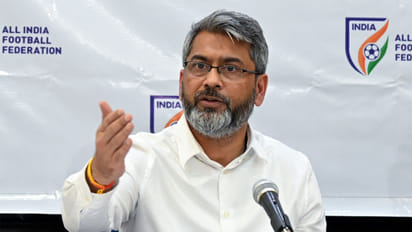
Kolkata (West Bengal) [India], November 23 (ANI): Ahead of the All India Football Federation (AIFF) elections scheduled for December 20, president Kalyan Chaubey has highlighted India's long association with organised football and its declining competitiveness at the continental and international levels, calling for a broader assessment of the sport's journey and collective accountability.
In a lengthy post on X, titled 'Facts about Indian Football', Chaubey traced the history of the game in India, pointing out that the Indian Football Association (IFA), based in West Bengal, was established in Kolkata in 1893, 11 years before FIFA was founded in Paris in 1904. He also highlighted the establishment of the AIFF in Shimla in 1937 and the Asian Football Confederation (AFC) in Manila in 1954, saying the timeline reflected India's early association with organised football. "It is reasonable to believe that India was among the early football-playing nations when the international game was still developing," Chaubey wrote on X.
Facts About @IndianFootball 1/10 Football in British India began much earlier than the establishment of FIFA. The Indian Football Association (IFA), West Bengal, was established in Kolkata in 1893, FIFA was founded in Paris in 1904, the All India Football Federation (AIFF) was established in Shimla in 1937, and the Asian Football Confederation (AFC) was founded in Manila in 1954. This historical timeline reflects India's early association with organised football. It is reasonable to believe that India was among the early football-playing nations when the international game was still developing. Independent India participated in the Olympic Games in 1948, 1952, 1956 and 1960. In the Asian Games, India won the football gold medal twice, in 1951 and 1962, when six and eight countries respectively participated in the football competition. However, after these achievements, India gradually lost its position and has not been able to make a significant impact in the Olympic Games or at the highest levels of Asian football. Today, the Asian football landscape has expanded considerably, with 47 member associations competing within the AFC framework.
1. How World Football Has Changed Over the Last 40 Years (1986–2026) In 1986, the football world witnessed the extraordinary brilliance of Diego Maradona at the FIFA World Cup in Mexico. At that time, 24 countries participated in 52 matches. FIFA's revenues during that period were approximately US$100 million. Forty years later, Mexico has once again co-hosted the FIFA World Cup, alongside the USA and Canada. -The 2026 edition features 48 participating countries and 104 matches, while FIFA's revenues have grown to approximately US$15 billion. The transformation of international football over these four decades has been remarkable, not only technically and tactically but also commercially.
2. Where Was India Then, and Where Are We Today? India suffered a 10–1 defeat against Yugoslavia at the 1952 Helsinki Olympic Games and later lost 9–1 to Kuwait in 2010. What were our results in Asia Cup, when we played teams other than SAFF region? -in 2023, we lost all three matches against Australia, Syria, Uzbekistan. -In 2019, we finished at bottom of the table, lost to UAE and Bahrain. -In 2015, we dropped lowest 173rd in FIFA ranking. - In 2012, we lost to North Korea, Philippines and Tajikistan -In 2011, we lost to Australia, South Korea and Bahrain. -In 2010, we lost to Kyrgyzstan, Turkmenistan, North Korea. -In 2007, we lost 6 out of 6 matches, Japan, Yemen, Saudi Arabia, conceding 24 goals. -In 2004, lost to North Korea - In 2000, we lost to Bahrain, Uzbekistan -In 1996, we lost to Indonesia, Malaysia In qualifiers of World Cup? From 1998, only 7 wins in 35 matches, 19 defeats. Of those 6 wins were against SAFF region. FIFA introduced its world ranking system in 1992. India was ranked 143rd at that time. Our highest-ever ranking was 94th in 1996, while our lowest was 173rd in 2015. In 2026, India is ranked 141st. Does this ranking adequately reflect our aspirations? Or do we need to move beyond our comfort zone and regularly challenge ourselves against the top 50 footballing nations? Over the last 30 years, India has won 10 out of 11 SAFF Championship editions in which it participated. However, our FIFA friendly matches have often been arranged against relatively weaker opponents. During these four decades, Indian football has also witnessed considerable changes in its domestic structure, with competitions such as the Santosh Trophy, Durand Cup, DCM Trophy, Rovers Cup, Scissors Cup, IFA Shield, National Football League, I-League and Indian Super League. These competitions have contributed significantly to domestic football and club-level fan engagement. Nevertheless, we must also evaluate the competitive standard of our domestic leagues by examining the performance of Indian clubs in continental competitions and comparing our achievements in AFC. — Kalyan Chaubey (@kalyanchaubey) November 23, 2026
Recalling India's achievements in the early years after Independence, he noted that the country participated in four consecutive Olympic Games between 1948 and 1960 and won football gold medals at the Asian Games in 1951 and 1962. However, he underlined the subsequent decline in India's international standing, contrasting the country's early achievements with its struggles to make an impact in Asian football. Comparing the global growth of the sport over the last four decades, Chaubey pointed to the expansion of the FIFA World Cup from 24 teams and 52 matches in 1986 to 48 teams and 104 matches in the 2026 edition. He also highlighted the commercial growth of the global game, with FIFA's revenues rising from approximately USD 100 million in 1986 to around USD 15 billion in 2026. Turning his attention to India's performances, Chaubey recalled disappointing results in major international competitions, including defeats against Australia, Syria and Uzbekistan in the 2023 Asian Cup and losses against the UAE and Bahrain in the 2019 edition. He also highlighted India's FIFA ranking, which reached its highest position of 94th in 1996 before dropping to 173rd in 2015. India is currently ranked 141st, according to the figures cited in his post. "Does this ranking adequately reflect our aspirations? Or do we need to move beyond our comfort zone and regularly challenge ourselves against the top 50 footballing nations?" he questioned.
Chaubey further pointed out that India had won 10 of the 11 SAFF Championship editions in which it participated over the last 30 years, while raising questions about the quality of opposition in the country's international friendly matches. He also referred to the evolution of India's domestic football structure, citing competitions such as the Santosh Trophy, Durand Cup, IFA Shield, National Football League, I-League and Indian Super League. However, he stressed the need to assess the competitive standards of domestic football by examining the performances of Indian clubs in continental competitions and comparing their achievements in the AFC.
Chaubey's post comes amid growing criticism of the state of Indian football ahead of the December 20 AIFF elections. He had earlier announced plans to present a detailed account of his four-year tenure and called on former office-bearers who had held positions of responsibility to share reports of their respective tenures. The previous AIFF elections were held on September 2, 2022, when Chaubey took charge as president for a four-year term. Meanwhile, former AIFF president Praful Patel, who headed the federation from October 2009 to May 2022, has also expressed concern over the state of Indian football, despite the growing fan interest and passion for the sport. Reflecting on his tenure, Patel highlighted the transition of Indian football from an amateur setup to a professional league structure but maintained that considerable work remained to achieve the sport's desired growth. He also flagged the challenges faced by Indian football over the last four years, including the impact on players, fans and other stakeholders, as well as the exit of several corporate entities from the football ecosystem. Patel noted that the AIFF had navigated a difficult period despite efforts by stakeholders to extend support to the governing body. (ANI)