Summer horror: Bengaluru staring at water crisis as dam levels plummet
Synopsis
BWSSB doesn’t expect the live storage at the KRS dam to last beyond two months. Exploitation of underground reserves would need the assent of the Cauvery Monitoring Committee. Nearly 50% of the water supplied in Bengaluru is lost due to illegal usage and inefficient infrastructure.
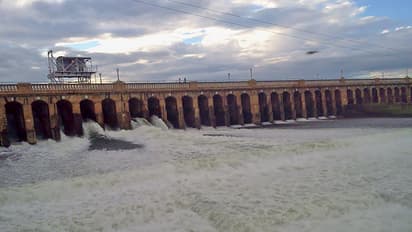
Confirming fears of tough months ahead for the water situation in Bengaluru, government officials have said that the “live” storage at the Krishnaraja Sagar (KRS) dam will not last beyond two months. The government is contemplating emergency measures such as the drilling of 300 borewells.
Explaining the situation to the Deccan Herald, officials of the Bangalore Water Supply and Sewerage Board (BWSSB) and the Cauvery Neeravari Nigam Limited (CNNL) said that as of January 23, the live storage at the KRS was approximately 6.058tmcft. The government is planning to install high-power pumps to draw water from the “dead” storage of the KRS. Water from the dead storage cannot be obtained by gravity but will need to be pumped out. The KRS had an estimated dead storage capacity of 4.4tmcft.
However, utilising the dead storage capacity of the KRS would require the consent of the Cauvery Monitoring Committee (CMC). This could be politically contentious given the severe drought situation persisting in Tamil Nadu.
The water levels at the KRS bring greater gloom to Bengaluru as only the southern and southwestern parts of the city can currently get Cauvery water — the northern and northeastern parts are dependent on groundwater, which is rapidly depleting. The city’s Revised Master Plan, 2031, estimates that nearly 85% of the groundwater has been exploited. The News Minute recently reported that the BWSSB currently supplies 1,470 million litres per day (MLD) to the city; of this, nearly 50% is lost because of illegal usage and inefficient infrastructure. Private borewells that were illegally dug have also eaten into groundwater levels.
In addition to manmade actions affecting the supply of water, the age of infrastructure is also a major impediment. The BWSSB announced that of the 56 ground-level reservoirs that hold Cauvery water in the city, around 15 had leakage issues; most of these sites are over 35 years old.
While there are several potential solutions to Bengaluru’s water woes, most are hampered by implementation issues. Desiltation of the catchment areas of lakes in the city has not taken off on a large scale even as the depth of several lakes has come down significantly since the 1970s. Mandatory installation of rainwater harvesting and sewage treatment facilities for residential and commercial establishments has provoked protests from residents, prompting the government to hold off on implementation.
(Image source: Wikimedia Commons)