Oh fish! Did we just eat that?
Synopsis
While many fish markets in the city witness a mad rush to buy fresh water fish, little do they know that the fish have harmful amounts of cadmium, chromium, lead and mercury content in it.
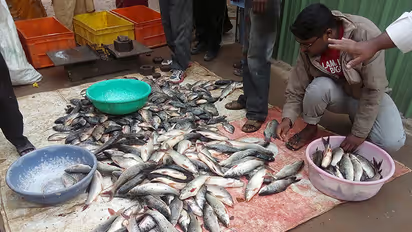
It is highly likely that the fish you're eating has floated up on a lake somewhere in the city and died of either pollutants or asphyxiation. Professor TV Ramachandra, an ecological engineer at the Centre for Ecological Science in the Indian Institute of Science (IISC) conducted a study on the recent fish mortality including the episodes of large-scale fish mortality rate in Ulsoor, Devarabisanahalli and Hebbal lakes in Bangalore.
An analysis of the water and fish samples reveal that the unusual fish deaths in Ulsoor and Devarabisanahalli lakes were due to asphyxiation, a sudden fall in dissolved oxygen (DO) levels, in some locations caused by the sustained inflow of untreated sewage.

Enhanced biochemical activities of algae, bacteria, as well as plant respiratory rate have lead to the depletion of DO levels in these lakes.
"The consumers are ignorant about these chemical and technical factors. Also, the officials and public representatives who are supposed to ensure the safety of lakes and its life, have turned a blind eye. In the long run, consumption of fish from such polluted lakes will lead to kidney ailments," said Ramachandra.
Referring to the study, Ramprasad, convener of a group called Friends of Lake, said, "Many people don't know what they eat. The question here is not about the dead fish and the fish that is caught in the net being sold, but about the safety. The fish may have poisonous chemical content".
Friends of Lakes is an anonymous group that works towards the rejuvenation and restoration of lakes in Bangalore.
The group has also insisted that the State Pollution Board take steps to prevent these situations by directing the civic agencies that have failed in the protection of flora, fauna, and aquatic life.
"We have conducted inspections in over 40 lakes and the board has arrived at a conclusion that the lakes which fall under the 'E' category, will be deemed unfit for fish culture," said Ramprasad.
The report had indicated that in March 2015, the lake fell under the 'D' category and hence fish culture was allowed. "We issued notices to agencies like Bangalore Water Supply and Sewerage Board (BWSSB) to divert sewage. The situation of fishkill arises during heavy rains as the sewage from manholes flood into storm water drains and enters lakes. The officials have been asked to ensure these incidents are not repeated," said Lakshman, Chairman, Karnataka State Pollution Control Board (KSPCB).
"A kilo of Rohu fish costs ₹120 at the auction and same will cost over ₹150 at the market hence we buy it from the lake during the auction," says Mosin Khan, a regular walker at Ulsoor Park.
The Bengaluru District Fish Production, Processing Marketing Co-operative Society that auctions fishes from Ulsoor lake said, fishing activity in city lakes falls under the jurisdiction of the Fisheries Department and that they have leased it for five years to various cooperative societies. The fish is sold amongst the members of these societies at reasonable rates to provide employment opportunities to its members.
"The lake water is free of sewage and the fish is clean, we have tested and we have the report, our fishermen community buy fish from us and sell in Shivajinagar, Tannery Road, and other places," states an official.