US-Israel Strikes On Iran Spark $10.3M Crypto Exit As Iranian Exchange Outflows Surge 873%

Synopsis
According to a report by Chainalysis, a significant chunk of the outflows went into self-custodial wallets instead of being transferred to other exchanges after the U.S.-Israel airstrikes on Iran over the weekend.
- Bitcoin’s price climbed over $71,000 on Wednesday morning while equity indices edged lower in pre-market trade.
- Data from Chainalysis showed that the ongoing conflict led to total outflows from Iranian crypto exchanges reaching $10.3 million.
- The outflow transaction volume surged as much as 873% above the 2026 hourly average.
Outflows from Iranian crypto exchanges surged after the weekend U.S.-Israel airstrikes on Iran to $10.3 million, according to on-chain data, and a big part of it went into self-custodial wallets instead of being transferred to other crypto exchanges, both foreign and domestic.
The conflict in the Middle East is on its fifth day now. Iran declared that the Strait of Hormuz is no longer open to the world, except for China, which it pegged as an ally.
Data from Chainalysis showed that the weekend airstrikes led to total outflows from Iranian crypto exchanges reaching $10.3 million. Hourly volumes surged as much as 873% above the average to over $2 million per hour. Chainalysisnoted that outflow volumes had been climbing before the airstrikes “as Iranians likely anticipated further conflict amidst heightened tensions.”
Bitcoin’s price rose more than 6% in the last 24 hours, to cross $71,000 on Wednesday morning, showing resilience amid the current conflict in the Middle East, while the SPDR S&P 500 ETF Trust (SPY) edged 0.16% lower in pre-market trade and SPDR Dow Jones Industrial Average ETF (DIA) dipped 0.25%. Retail sentiment around the apex cryptocurrency on Stocktwits remained in ‘bullish’ territory over the past day.

Why Are Crypto Traders In Iran Pulling Tokens Off Exchanges?
The firm’s on-chain analysis revealed that while a chunk of transfers went to other exchanges, both overseas and domestic, a notable portion of the outflows moved into “other wallets.”
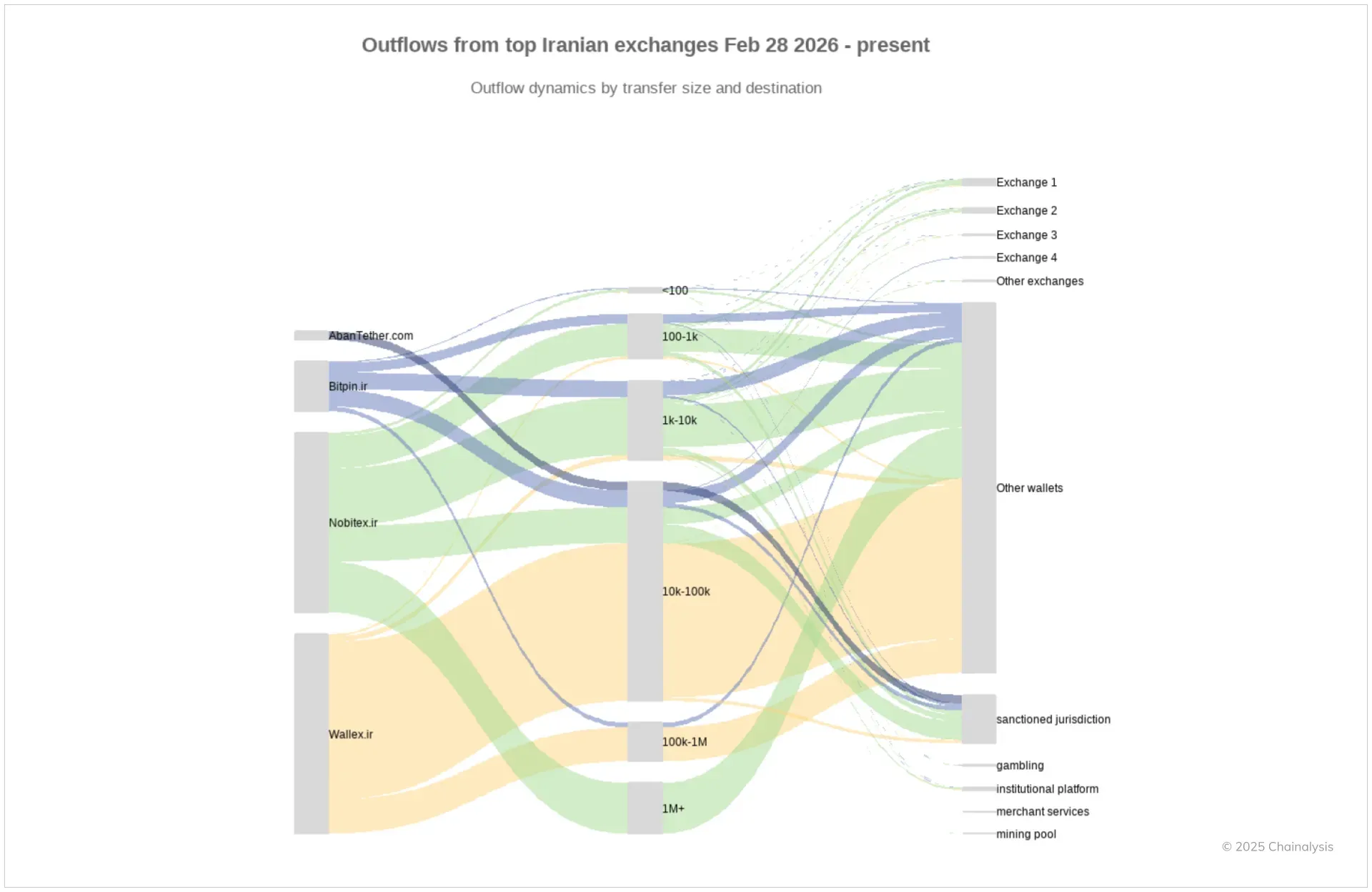
Chainalysis said the most plausible explanation is that ordinary users are pulling tokens off centralized exchanges into self-custody wallets as a hedge against instability, as per the trends seen during recent protest waves. “Self-custodial crypto wallets provide safety and liquidity and preserve optionality,” the firm wrote.
Alternatively, Chainalysis said the movement could just be exchanges moving crypto out of the country in a way that can’t be tracked to a main exchange to avoid sanctions. It noted that a third possibility is state-aligned actors using mainstream Iranian exchanges for money laundering and cross-border trade, as they have in the past.
“IRGC-linked and other state actors have historically relied on local platforms and their counterparties to move and cash out funds tied to sanctions evasion, proxy financing, and illicit trade,” the firm wrote. “Some portion of the current flows could therefore reflect these actors moving funds through the same domestic rails in a time of heightened volatility.”
Crypto Holds Amid U.S.-Iran Tensions
The cryptocurrency market has held strong even after the S&P 500, gold, and the South Korean stock market wavered in the face of military conflict between the U.S., Israel, and Iran.
According to Bitwise chief investment officer Matt Hougan, the U.S.-Israel attack on Iran over the weekend is a strong case for why on-chain finance is a necessity. “The shift to on-chain finance is inevitable. After this weekend, I’m convinced that shift is coming sooner than any of us had imagined,” he wrote in a note about how Hyperliquid (HYPE) allowed traders to access the market while stock markets were closed.
Read also: KOSPI, S&P 500, Gold Sink On US-Iran Tensions, But Bitcoin Holds $68K Floor
For updates and corrections, email newsroom[at]stocktwits[dot]com.<
Stay updated with all the latest Business NewsShare Market NewsIPOsGold PriceDA Hike8th Pay CommissionAsianet News Official App