Fed’s Barr Warns AI Investment Reversal Could Trigger ‘Self-Reinforcing Fire Sales’
Synopsis
The Fed Governor said he is less concerned about direct losses given the still-limited debt backing the AI boom, but flagged rising leverage in equity strategies.
- Barr said on-balance-sheet debt at the seven largest AI firms is expected to exceed $800 billion before year-end.
- He described more than $100 billion in equity investments by hyperscalers and GPU makers in AI startups as “circular financing.”
- Barr said hyperscalers’ capex and debt issuance haven’t yet surpassed the telecom boom, but “they may do so soon.”
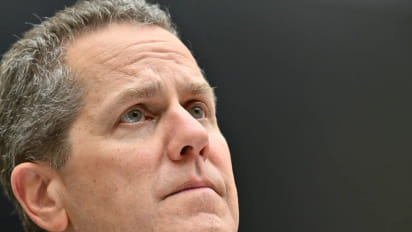
Federal Reserve Governor Michael Barr warned Monday that a sharp reversal in artificial intelligence (AI) investments could trigger rapid deleveraging and potentially “self-reinforcing fire sales,” citing risks from hedge-fund leverage.
Speaking at an AI finance conference in Milan, Barr discussed findings from the Fed's latest Financial Stability Report. He stressed that Fed policymakers “do not target levels of financial markets” and said he remained optimistic about AI's long-term potential.
AI Firms Face Over $3 Trillion In Potential Obligations
Barr said on-balance-sheet debt at the seven largest AI firms is expected to exceed $800 billion before year-end.
The Fed Governor cited the central bank’s estimate that the potential maximum nominal value of their off-balance-sheet obligations exceeds $3 trillion, including long-term contracts, leases and residual value guarantees, which have grown faster than on-balance-sheet debt.
Barr noted that firms generally present off-balance-sheet liabilities before discounting, which “complicates comparisons” with discounted on-balance-sheet figures.
He also cited the report’s comparison of hyperscalers' cumulative capital spending and debt issuance since 2020 with the telecom broadband investment cycle beginning in 1995. While they have yet to surpass their earlier counterparts, recent spending acceleration suggests “they may do so soon,” Barr said.
Risks From ‘Circular Financing’
Barr highlighted more than $100 billion in cumulative equity investments by hyperscalers and graphics processing unit (GPU) manufacturers in large language model laboratories and cloud-computing startups.
“These equity investments represent a form of ‘circular financing’ in which hyperscaler firms and GPU makers invest capital in smaller firms, and the smaller firms turn around and use these funds to rent or purchase GPUs and compute from the firm that made the investment,” he said.
Barr noted these investments represent a relatively small share of larger firms' balance sheets but are “critical for the smaller firms receiving the investments.” He also warned that lower-credit-quality firms dependent on external funding have faced significantly higher capital costs and are turning to more complex asset-backed financing.
Barr Less Concerned About Direct Losses
“Given the still-limited amount of debt backing the current boom, I'm less concerned about direct losses,” Barr said. However, he noted that leverage in equity strategies has increased, partly through large dealers' prime brokerage services.
While high capital levels at major banks provide a “bulwark against spillovers,” Barr said counterparty exposures could rise during equity market volatility. He also acknowledged that the AI investment boom could continue without a downturn.
“Or maybe there will be no AI investment fizzle but a continued boom, and our demand for AI services will make full use of the capital being installed now and then some. Only time will tell,” Barr said.
Markets Brace For Nvidia Earnings, Anthropic IPO
Barr’s remarks come ahead of an important week for AI, with Nvidia (NVDA) set to report quarterly earnings on Tuesday and Anthropic's (ANT) public markets debut on Thursday.
At the time of this writing, U.S. stock futures were mixed, with Nasdaq-100 futures down 0.79% and S&P 500 futures down 0.25%. Meanwhile, Dow futures edged up 21 points, or nearly 0.1%.
Among major index-tracking ETFs, the SPDR S&P 500 ETF (SPY) and Invesco QQQ Trust (QQQ) edged lower, while the SPDR Dow Jones Industrial Average ETF (DIA) ticked higher. On Stocktwits, retail sentiment was ‘extremely bullish’ for SPY and ‘bullish’ for both QQQ and DIA.
The iShares Semiconductor ETF (SOXX) also fell over 3% in Monday’s premarket trading, following a 3.6% decline on Friday, with retail sentiment on Stocktwits remaining ‘bearish’.
See Also: NVDA Earnings Preview: Nvidia’s AI Engine Is Running, But Can It Keep Growing Without Its Chief Architect?
For updates and corrections, email newsroom[at]stocktwits[dot]com.<
Stay updated with all the latest Business NewsShare Market NewsIPOsGold PriceDA Hike8th Pay CommissionAsianet News Official App