Crypto’s Latest Bankruptcy: What Went Wrong At Blockfills

Synopsis
Before declaring bankruptcy, the company's finances were worsened by ongoing legal battles with Dominion Capital.
- Chicago-based crypto trading platform BlockFills filed for Chapter 11 bankruptcy in Delaware on Monday.
- The filing added to a growing list of crypto firms restructuring this year, including Archblock and NFN8 Group.
- Analysts said many crypto startups continue to fail due to weak tokenomics, poor product-market fit, and funding challenges.
The Chicago-based cryptocurrency trading platform Blockfills on Monday filed for Chapter 11 bankruptcy in Delaware, making it the third major crypto company to do so this year.
Blockfills filed for Chapter 11 bankruptcy protection in the U.S. Bankruptcy Court for the District of Delaware after losing about $75 million, according to a filing.
Blockfills said on X that the decision came after “extensive discussions with investors, clients, creditors, and other stakeholders.” The company said that the restructuring under court supervision would help it stabilize its operations, improve cash flow, and explore strategic options, all while remaining open and honest with clients and creditors. Companies can continue operating while they reorganize their finances and develop a plan to repay their debts under Chapter 11.
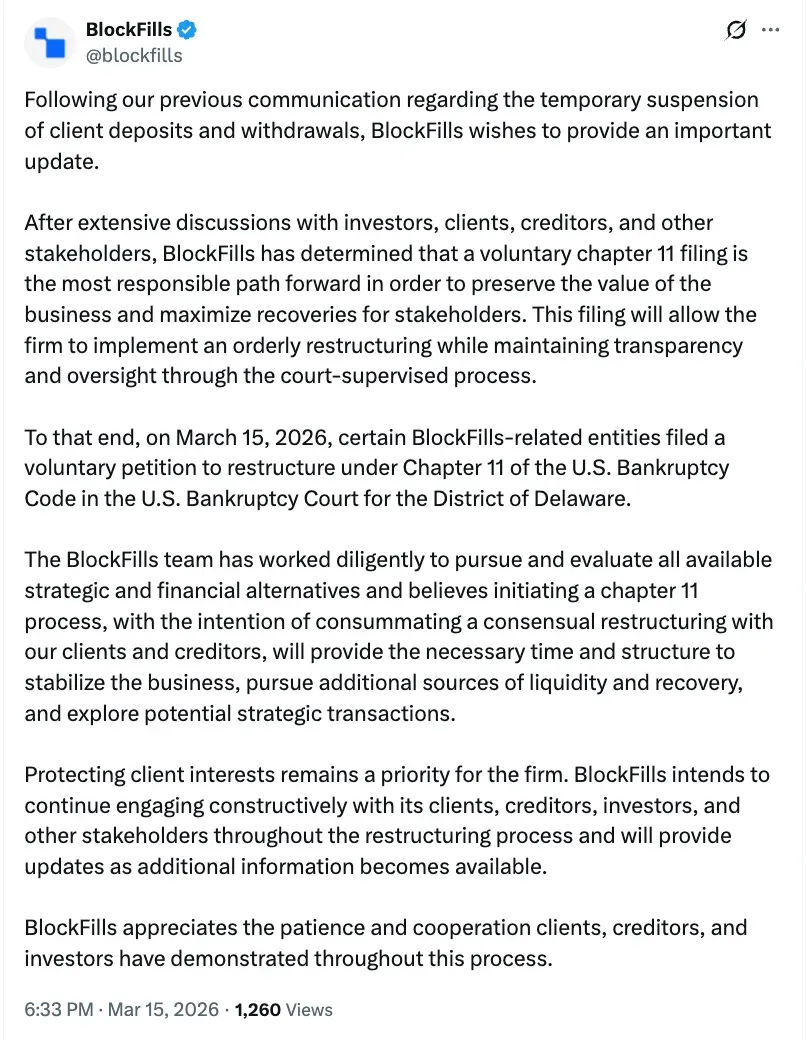
The filing followed months of financial stress at the firm. Previously, Blockfills blocked customers from withdrawing and depositing funds, limiting trading in an attempt to restore liquidity. Shortly afterward, CEO Nick Hammer stepped down, signaling deeper operational strain inside the company.
Prior to filing for bankruptcy, the company's financial situation was further strained by legal disputes with Dominion Capital.
Dominion Capital alleged that the company improperly handled and mixed customers’ crypto assets, which eventually led to a U.S. judge freezing approximately 70.6 Bitcoin (BTC) linked to the dispute, valued at around $5 million.
Bitcoin’s price was at $73,604, up over 2% in the last 24 hours. On Stocktwits, retail sentiment around BTC improved from ‘neutral’ to the ‘bullish’ zone, while chatter remained at ‘low’ levels over the past day.

Other Firms Filed For Bankruptcy
Over the past ten years, the cryptocurrency market has grown significantly. There are currently over 18,000 cryptocurrency tokens in use, and the market as a whole is estimated to be worth $2.58 trillion, as per CoinGecko. Every year, hundreds of new startups enter the market thanks to the comparatively low barriers to starting blockchain projects.
However, competition has also increased due to growth. Many crypto businesses struggle to make it past their early stages, while a small number have grown into significant platforms.
As part of a restructuring process, Archblock, a financial infrastructure company associated with the TrueUSD stablecoin ecosystem, filed for Chapter 11 protection earlier this year. Another cryptocurrency mining and infrastructure company, NFN8 Group, also declared bankruptcy in February due to financial strain and operational disruptions.
Crypto Startups Failure
Columbia Business School lecturer Omid Malekan stated that traditional finance (TradiFi) users in the crypto ecosystem generally prefer blockchains that are irreversible and censorship-resistant, as trust remains a key factor.
In another post on X, he said that he was “chronically disappointed by the tokenomics of most new projects. There are too many red flags and too much of a focus on rewarding insiders and early investors – as opposed to ensuring long-term sustainability and a path to neutrality.”
In 2025, over 11 million crypto projects failed – the highest failure rate recorded in a year, accounting for 86.3% of all crypto projects that died down between 2021 and 2025.
Read also: Strategy Snaps Up $1.57B Of Bitcoin, Narrows Gap With BlackRock’s IBIT
For updates and corrections, email newsroom[at]stocktwits[dot]com.<
Stay updated with all the latest Business NewsShare Market NewsIPOsGold PriceDA Hike8th Pay CommissionAsianet News Official App