Anthropic IPO Frenzy: SPCX, CBRS, ARM And Other Mega-Listings Show What Happens After The First-Day Pop
Synopsis
Anthropic's upcoming IPO could deliver a major first-day pop, but the track records of SpaceX, Cerebras, Arm, Alibaba and Facebook show why investors should look beyond the initial rally.
- Anthropic said on Tuesday it would stick to its proposed IPO price range of $70 to $78 per share before making its Nasdaq debut on Thursday.
- SpaceX and Cerebras both posted substantial first-day gains, but their shares have since fallen sharply from their initial trading levels.
- Alibaba remains above its IPO price but is still below the level at which investors who bought at its first-day close entered.
Anthropic (ANT) said on Tuesday it would stick to its proposed IPO price range of $70 to $78 per share, keeping its plans for one of the largest public-market debuts intact ahead of its Nasdaq listing.
The company is slated to make its Nasdaq debut on Thursday, with investors watching for a big first-day pop; however, the recent track record of mega-IPOs suggests the bigger test may come after the initial excitement fades.
SpaceX: From IPO Highs To A Near-Complete Reversal
The two most recent examples, SpaceX (SPCX) and Cerebras (CBRS), show how quickly enthusiasm around a high-profile listing can fade. Both stocks surged on their first day, but their subsequent performance has been sharply different from those initial gains.
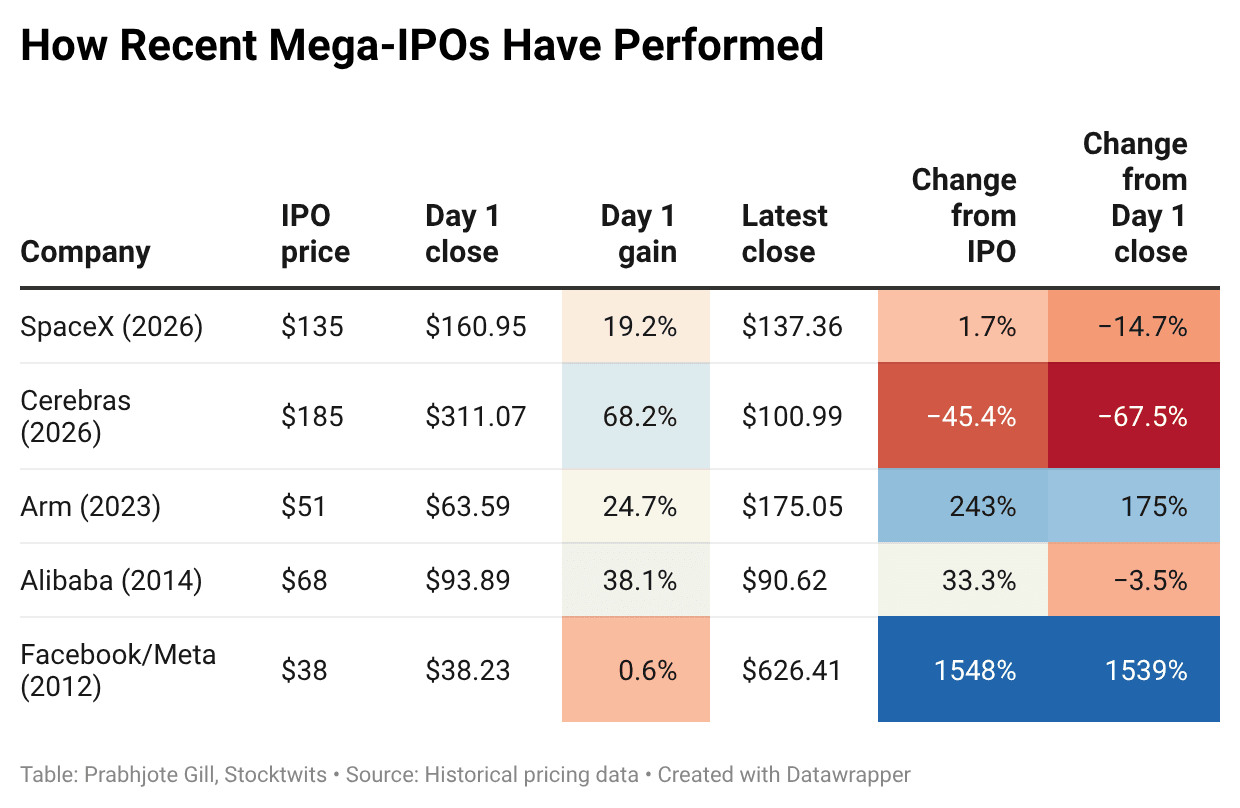
SpaceX priced its shares at $135 and opened at $150 on June 12. The stock reached an intraday high of $176.52 before closing its first session at $160.95, a 19.2% gain from the IPO price.
Shares initially continued climbing, reaching a peak of $225.64, but later fell about 50% from that high by late July. SPCX stock closed Monday just 1.7% above its IPO price and 14.7% below its first-day close.
Investors are also watching the company's December 8 lock-up expiration, when restrictions on certain shareholders selling their stock are due to end.

Cerebras: Debut Gains Turn Into Steep Losses
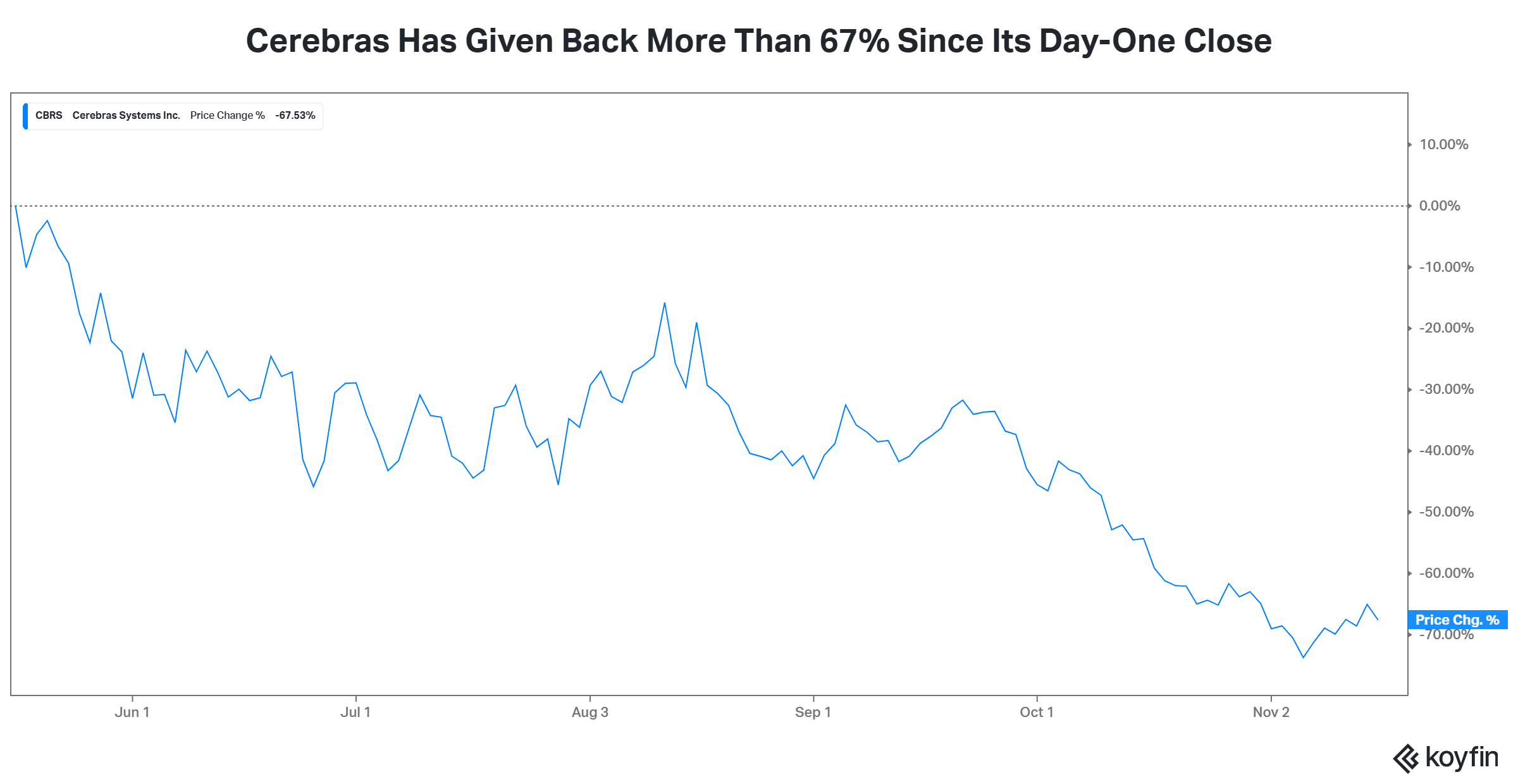
Cerebras Systems (CBRS) delivered an even bigger opening-day rally. The chipmaker priced its IPO at $185 on May 13, $25 above the top of its already-raised price range, and closed its first session at $311.07, up 68.2%.
Those gains have since reversed. CBRS stock is now 45.4% below its IPO price and 67.5% below its first-day close.
The Long-Term Winners
Arm Holdings (ARM), the last major chip IPO before the 2026 listing wave, offers a different outcome. The company priced its shares at $51 in September 2023 and closed its first trading day at $63.59, a 24.7% gain.
The initial excitement faded quickly. By the end of its IPO week, Arm had slipped to $52.16, barely above its IPO price. However, investors who held through the early volatility were eventually rewarded as demand for AI-related computing lifted the stock. ARM stock, at the time of writing, remains more than three times higher than its IPO price.
Meta Platforms (META), then Facebook, is another example of why a disappointing debut does not necessarily determine a company's long-term performance. Its 2012 IPO was plagued by technical problems at Nasdaq, and the stock finished its first session at $38.23, just above its $38 offer price.
The shares fell 33% below the IPO price within two weeks and took more than a year to recover to that level. Investors who stayed through that period have since seen substantial gains. META stock, at the time of writing, is trading at more than 16 times its IPO price.
Cautionary Tales
Alibaba Group (BABA) offers a more mixed result. The company priced its shares at $68 in September 2014, opened at $92.70 and closed its first trading day at $93.89, delivering a 38.1% gain from the IPO price.
Twelve years later, BABA stock remains above its IPO price, closing Monday at $90.62. However, investors who bought at the first-day close are still sitting on a loss of about 3.5%.
The broader IPO record also suggests that initial gains can overstate the returns available to investors entering the market after a listing. Research by Jay Ritter found that IPOs from 2012 through 2021 generated an average first-day return of 23.6%, but an average return of 10.6% over the following three years.
What The IPO History Means For Anthropic
Anthropic’s proposed $70 to $78 price range implies an equity value of about $1.02 trillion at the top of the range based on shares outstanding after the offering and concurrent private placement.
On a fully diluted basis, including stock options and other equity awards, the valuation could reach roughly $1.4 trillion. Both figures are below earlier speculation that Anthropic could seek a valuation of as much as $2 trillion. Anthropic's IPO prospectus sets out the share-price range and capital structure.
The offering also includes a $26 billion private placement in which seven of Anthropic's major technology suppliers have agreed to buy shares at the IPO price. The group includes Nvidia (NVDA), Alphabet's Google (GOOGL), Microsoft (MSFT), Advanced Micro Devices (AMD), Broadcom (AVGO), Micron Technology (MU) and Taiwan Semiconductor Manufacturing (TSM).
Strategists say the debut matters less than what comes next. “Just be aware you’re going to have a pop and probably some weakness looking at history with major IPOs,” said Ryan Detrick, chief market strategist at Carson Group. “It’s not so much what happens this week as what happens in subsequent weeks,” added Marta Norton, chief investment strategist at Empower.
Read also: Tom Lee Says Ethereum’s Slide Ahead Of Anthropic IPO Mirrors Its Sell-Off Before SpaceX IPO
For updates and corrections, email newsroom[at]stocktwits[dot]com.<
Stay updated with all the latest Business NewsShare Market NewsIPOsGold PriceDA Hike8th Pay CommissionAsianet News Official App