Kerala's Local Body Elections: Scandal and Strategy Eclipse Traditional Political Narratives
Synopsis
Kerala's local body elections have shifted from a focus on governance to a battle over credibility. The Sabarimala gold smuggling case has put the ruling LDF on the defensive, while a sexual assault allegation has done the same for the UDF.
Rather than focusing on developmental agendas and governance records, Kerala's local body elections has been commandeered by two explosive scandals that have placed both major political fronts on the defensive while creating an opening for the BJP to position itself as an alternative force.
The emergence of the Sabarimala gold smuggling case and a sexual assault allegation against a senior opposition figure have fundamentally reshaped the electoral landscape, transforming what should have been a straightforward policy-driven contest into a battle over credibility and character.
Semi-Final for 2026
The timing of these local body elections carries particular significance in Kerala's political calendar. With state assembly elections scheduled just five months after the panchayat polls conclude, this contest functions as a semi-final battle that will provide crucial momentum and voter sentiment indicators for the larger contest ahead.
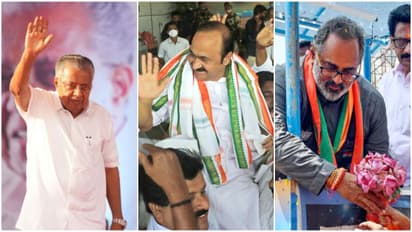
All three major political formations-the Left Democratic Front (LDF), the United Democratic Front (UDF), and the Bharatiya Janata Party (BJP)-have entered the fray with clearly defined objectives. The LDF seeks to consolidate support for a third Pinarayi Vijayan government, the UDF aims to dislodge what it characterizes as an anti-people administration, and the BJP is attempting to capitalize on dissatisfaction with both traditional fronts to establish itself as a decisive electoral force.
Sabarimala Gold Smuggling Case
The arrest of Padmakumar and N. Vasu in connection with the Sabarimala gold smuggling scandal proved to be the first major disruptive force in the campaign. The UDF and BJP swiftly weaponized the case, presenting it as evidence of systemic corruption within the CPM-led government and converting it into what political observers have termed a 'Brahmastra'-a decisive political instrument-against the ruling party.
The arrests sent shockwaves through CPM party centers, with cadres questioning where the party's senior leadership stood and what protective mechanisms, if any, existed within the organization. The unfolding scandal threatened to undermine the LDF's electoral position before the campaign had truly gained momentum.
The CPM's defensive posture was to argue that no individual, regardless of rank or position, would be shielded from the law. The party emphasized that anyone found guilty of stealing sacred temple assets would face imprisonment, attempting to frame the arrests as evidence of institutional accountability rather than systemic rot.
The Rahul Mamkootathil Rape Case
Just as the Sabarimala scandal appeared to be gaining irreversible traction against the government, the sexual assault case against Rahul Mamkootathil erupted with dramatic force. For the CPM, this development arrived as an unexpected lifeline that allowed the party and government to shift the narrative and counterattack with institutional force.
The government's swift and visible response to the rape allegations-demonstrating willingness to act against one of its own political allies-provided the LDF with ammunition to challenge the UDF's positioning as the "anti-corruption" alternative. The counterattack left the UDF momentarily disoriented, struggling to maintain its moral authority on the issue of governmental accountability.
BJP's Opportunistic Campaign Strategy
While the two traditional fronts battled over the fallout from these scandals, the BJP employed a strategic pivot to exploit the situation. The party's campaign messaging emphasized that both the LDF and UDF were equally compromised, presenting itself as the only force capable of offering clean governance and developmental focus.
Leveraging backing from the central government, the BJP presented an ambitious development agenda that extended down to the panchayat level. Party leaders made bold campaign pronouncements, ranging from hosting the Olympic Games in the state capital to advocating for central government takeover of the Sabarimala temple management.
These positioning moves were designed to appeal to voters fatigued by the scandals dominating both traditional political camps and seeking a fresh alternative.
Local Issues Resurface Amid the Noise
Despite the headline-grabbing scandals, local political leaders report that discussions about tangible developmental outcomes and failures at the regional level have also permeated village discourse across the state. Voters are simultaneously engaging with both the scandal-driven national narrative and the granular local issues that directly affect their daily lives.
Democracy on Display
As thousands of candidates from various parties and their supporting workers traverse villages across Kerala with appeals for electoral support, the campaign remains a testament to the participatory nature of Indian democracy. The diversity of voices, perspectives, and competing visions for governance being presented to voters reflects the system's inherent strength and dynamism.
With public campaigning for the first phase concluding this evening, attention now turns to the electorate's verdict and which political force will gain the momentum heading into the state assembly elections scheduled for mid-2026.
Stay updated with the Breaking News Today and Latest News from across India and around the world. Get real-time updates, in-depth analysis, and comprehensive coverage of India News, World News, Indian Defence News, Kerala News, and Karnataka News. From politics to current affairs, follow every major story as it unfolds. Download the Asianet News Official App to stay informed anytime, anywhere.