‘Taking Lives And Costing Lakhs’: Bengaluru Traffic Crisis Highlights Health Risks, Road Deaths And Rising Costs
Synopsis
A viral social media post highlights Bengaluru’s traffic crisis, citing health risks, road fatalities, rising commuting costs and delays in public transport improvements. The post urges authorities to address the city’s growing civic challenges.
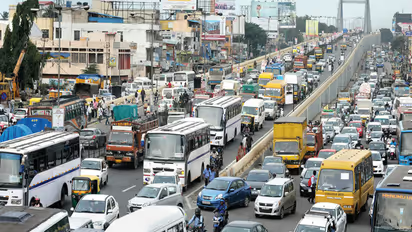
Bengaluru’s worsening traffic congestion has raised concerns about road safety, public transport and residents’ access to essential services. A detailed social media post by the CEO and co-founder of Prosperr.io has highlighted the scale of the problem, explaining how traffic jams can affect emergency medical response times, reduce productivity and increase the cost of living. The post also draws attention to road fatalities, inadequate public transport infrastructure and delays in civic improvements, urging authorities to take immediate steps to address the city’s growing traffic crisis.
Bengaluru Traffic Congestion Raises Health And Safety Concerns
In a post highlighting the city’s traffic conditions, the entrepreneur argued that congestion was no longer merely an inconvenience but had become a serious civic and public health concern. The post presented figures on emergency response times, road accidents, commuting costs and access to essential public facilities.
According to the figures shared, traffic congestion during peak hours can add around 25 minutes to an ambulance journey at 6 pm. The post also cited research indicating that, following a heart attack, every 30-minute delay before treatment is associated with a 7.5% increase in the risk of dying within a year.
The post also highlighted a fatal accident in August in which a 32-year-old woman was reportedly killed after the two-wheeler she was travelling on swerved to avoid a pothole. The incident was cited as an example of the potentially serious consequences of poor road conditions and civic negligence.
Enough is enough. We mapped Bengaluru traffic to prove it is a huge civic and health risk that is taking lives and costing us lakhs just to exist here.
Some extremely sad data we found:
i) In a heart attack every 30 minutes of delay before treatment raises the risk of dying within a year by 7.5%. At 6 pm traffic here can add 25 minutes to an ambulance ride.
ii) Bengaluru has the most deaths from civic negligence in India. In August a 32 year old woman was killed when the bike she was on swerved around a pothole.
iii) Rush hour takes about a month of working hours from a commuter every year, like an 8% pay cut. Living near the tech parks to avoid it costs ₹1.6 to ₹2.4 lakh more a year in rent.
iv) You have access to only 3 out of 10 essential public facilities (schools, hospitals, toilets etc) at 6pm within a 30 minute vicinity.
v) The ORR carries more than double the traffic it can handle. Last year a company said it would leave Bellandur over 1.5 hour commutes and another state invited it within a day.
vi) The ORR bus lane cut bus trips by about 20 minutes. It was removed in 2022 for metro work and still is not back.
This is intolerable for a city that drives so much of India's economy. We cannot let India's Silicon Valley stall.
My team has put the most immediate fixes that will help solve this + how delayed/pushed they have been. Tag the people who can fix it: Traffic police or Namma Metro or GBA or the CM's office and let us all be honest and tell us what 6 pm has cost you.
#Bengaluru #BengaluruTraffic
— Manas Gond (@manasgond) October 9, 2026
Traffic Jams Affect Productivity And Increase Living Costs
Beyond road safety, Bengaluru’s traffic congestion is also affecting commuters financially and professionally. According to the post, the time lost during rush hour adds up to approximately one month of working hours each year for a regular commuter. The author compared this loss to an 8% pay cut.
The post also highlighted the additional cost of living closer to major technology parks to reduce commuting time. According to the figures shared, renting a home near these employment hubs can cost an additional ₹1.6 lakh to ₹2.4 lakh annually.
Traffic congestion also affects access to essential services. The post claimed that at 6 pm, residents could reach only three out of 10 essential public facilities, including schools, hospitals and public toilets, within a 30-minute journey.
Outer Ring Road Traffic And Bus Lane Delays Draw Attention
Bengaluru’s Outer Ring Road (ORR), a major corridor connecting several technology hubs, was another key focus of the post. The author claimed that the road carries more than twice the volume of traffic it was designed to handle, worsening congestion for employees and businesses operating in the area.
The post also referred to concerns raised by a company over lengthy commutes in Bellandur, reportedly prompting it to consider moving out of the area. According to the author, another state invited the company to relocate there within a day, highlighting the potential economic consequences of Bengaluru’s infrastructure challenges.
The removal of the dedicated ORR bus lane was also criticised. According to the post, the bus lane had reduced bus journey times by approximately 20 minutes before it was removed in 2022 to facilitate metro construction. The author noted that no confirmed date had been announced for its return.
Road Fatalities Highlight Bengaluru’s Civic Challenges
The post cited several figures to underline the scale of Bengaluru’s road safety challenges. According to the data shared, the city recorded 896 fatal road crashes last year, equivalent to approximately one every 10 hours.
It also stated that 246 pedestrians were killed in Bengaluru in 2024, placing the city second among major Indian cities for pedestrian fatalities, according to the figures cited.
The post called for immediate measures to improve road safety, traffic management and public transport. It argued that a city contributing significantly to India’s economy could not afford to let congestion and infrastructure shortcomings continue unchecked.
The author also said the team had prepared a detailed set of proposed solutions, along with information on measures that had been delayed or postponed.
Social Media Users Discuss Possible Solutions
The post prompted social media users to discuss potential improvements to Bengaluru’s traffic management system, public transport infrastructure and road network. Some highlighted the importance of using traffic data to identify bottlenecks, while others pointed to shortcomings in existing bus lanes and the need for better last-mile connectivity to metro stations.
One user commented: "Great stuff. Meanwhile what does it take for intelligent stuff like this to also map road traffic data to suggest fixes. Signals, road bottlenecks , lane crossing etc. so much can be done out there too."
The author replied to the comment: "My team can take a shot if we had the data. A lot of this data is very scrupulous and varied and also has a lot of holes, as you can imagine."
@manasgond Great stuff. Meanwhile what does it take for intelligent stuff like this to also map road traffic data to suggest fixes. Signals, road bottlenecks , lane crossing etc. so much can be done out there too.
— Balaji Partha (@BalajiPart90315) October 9, 2026
A second user commented: "The dedicated bus lane on ORR wont workout due to its flaws.Without proper bypass bays, a single stationary bus instantly triggers a domino effect, causing immediate tailbacks and halting all subsequent buses."
A third user commented: "For every metro station last mile connectivity is a must for metro to be used by everyone."
@manasgond For every metro station last mile connectivity is a must for metro to be used by everyone
— Asis Agarwal (@asis_agarwal) October 9, 2026
Calls For Urgent Action On Bengaluru Traffic
The post urged residents to bring the city’s traffic challenges to the attention of relevant authorities, including the traffic police, Namma Metro, the Greater Bengaluru Authority (GBA) and the Chief Minister’s Office.
The author also invited residents to share how the daily 6 pm traffic affected their lives. Journalists were encouraged to request the detailed research brief, which reportedly contains the methodology and sources behind the figures.
The post has renewed attention on the need for coordinated action to improve traffic management, road maintenance, emergency access and public transport connectivity in Bengaluru. As the city continues to grow as a major technology and business hub, addressing these challenges will be essential to improving road safety, reducing commuting costs and making daily travel more reliable for residents.
Stay updated with the Breaking News Today and Latest News from across India and around the world. Get real-time updates, in-depth analysis, and comprehensive coverage of India News, World News, Indian Defence News, Kerala News, and Karnataka News. From politics to current affairs, follow every major story as it unfolds. Download the Asianet News Official App from the Android Play Store and iPhone App Store for accurate and timely news updates anytime, anywhere.