Karnataka: Rare Vijayanagara-era Dashavatara doorframe found at Udupi's Ananthapadmanabha Temple
Synopsis
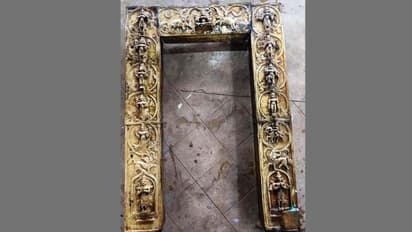
A rare Vijayanagara-era Dashavatara doorframe featuring Vishnu’s ten incarnations has been discovered at Ananthapadmanabha Temple in Udupi, Karnataka. The artifact dates back to the reign of Krishnadevaraya in 1519 AD.
Bengaluru: An ancient metal doorframe from the Vijayanagara period, featuring sculptures of the ten incarnations of Vishnu (Dashavatara), has been discovered at the Ananthapadmanabha Temple in Perdur village, Udupi taluk.
Prof. T. Murugeshi, Associate Professor of Archaeology and founding member of the Udupi Adima Kala Trust, confirmed the find, stating:
"A rare doorframe (Dwara Bandha) with a Dashavatara sculpture panel from the Vijayanagara period has been found at the Perdur Ananthapadmanabha Temple in Udupi taluk."
Artistic and symbolic details of the doorframe
The temple is dedicated to Ananthapadmanabha, a principal deity of the Bhagavata sect on India’s west coast. The newly discovered doorframe is approximately 4.5 feet high and 3.5 feet wide and features intricate iconography.
At its centre is a panel of Gajalakshmi, seated on an elevated platform, flanked by elephants performing abhisheka (ritual bathing) with pots of holy water. Above them, the sun and moon are depicted, signifying eternal cosmic presence.
On the lintel, Gajalakshmi’s forehead image is prominently displayed. The vertical panels feature:
- Anjaneya in Anjali Mudra
- Vyalis (mythical lion-like creatures)
- Between creeping vine motifs emerging from the Vyali faces, the five avatars:
- Matsya, Kurma, Varaha, Narasimha, and Vamana
Further along the panel are:
Parashurama, Rama, Krishna (depicted subduing the Kaliya serpent), Buddha, Kalki, and Garuda in Anjali Mudra
Historical context and inscriptions
An inscription found within the temple’s inner sanctum dates back to 1519 AD, during the reign of Vijayanagara emperor Krishnadevaraya.
The inscription states that the emperor:
- Made generous donations to the temple
- Appointed an officer named Surappaiah to oversee temple administration
- It is believed that the stone additions to the temple, including the Dashavatara doorframe, were undertaken during this period.
Krishnadevaraya’s military campaigns, particularly against the Gajapatis of Orissa, resulted in the acquisition of the ‘Butterball Krishna’ idol. He installed it in a newly constructed temple at Hampi, and it soon gained popularity across the Vijayanagara Empire. A depiction of this idol on the Perdur doorframe further supports its dating to this era.
Another similar representation of minimalistically carved Buddha is found in the Vidyashankara Temple in Sringeri, making this discovery significant in terms of art history and religious symbolism.
Acknowledgements and research team
Prof. Murugeshi extended his thanks to:
- Pramod Rai Palaje, temple president
- Gururaj, administrative officer
- Trustees and priests of the temple for their support during the research
He also acknowledged the contribution of the Adima Kala Trust (R) research team: Shreyas Kolpe, Shreyas Bantkal, Gautam Belman, Ravindra Kushwa (Shirva), Dhanush, and Keerthan Udupi.
Stay updated with the Breaking News Today and Latest News from across India and around the world. Get real-time updates, in-depth analysis, and comprehensive coverage of India News, World News, Indian Defence News, Kerala News, and Karnataka News. From politics to current affairs, follow every major story as it unfolds. Download the Asianet News Official App from the Android Play Store and iPhone App Store for accurate and timely news updates anytime, anywhere.