Karnataka: Man Travels 300 Km to Donate Rare Bombay Blood to 3-Year-Old Boy
Synopsis
A man from Chikkamagaluru travelled over 300 km to Dharwad to donate rare Bombay blood to three-year-old Abhinandan, who was critically ill due to severe bleeding. The Swami Vivekananda Blood Donors Foundation helped locate the compatible donor.
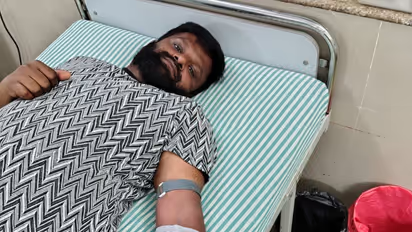
A three-year-old boy battling a rare genetic bleeding disorder received timely help after a man travelled more than 300 km to donate blood from the extremely rare Bombay blood group. Maheshkumar, from Chikkamagaluru, travelled to Dharwad after learning that the child urgently needed a compatible donor. His selfless gesture has drawn appreciation for his willingness to travel several hours to help a child he had never met.
Three-Year-Old Boy Needs Rare Blood Group
Abhinandan was undergoing treatment at SDM Hospital in Dharwad when he developed severe bleeding, causing his haemoglobin levels to drop significantly. As his condition became critical, doctors said he urgently needed one unit of Bombay blood. Finding a compatible donor was a major challenge because this blood group is extremely rare.
Father Seeks Help to Find a Donor
The child's father, Mahantesh, appealed for help. The Swami Vivekananda Blood Donors Foundation stepped in to find a suitable donor. Its founder, Shivakumar Rattihaalli, traced Maheshkumar to Chikkamagaluru and contacted him to explain the child's critical condition.
After learning about the emergency, Maheshkumar agreed to donate blood without hesitation. He immediately set off for Dharwad, travelling for more than five hours and covering over 300 km to reach SDM Hospital.
After completing the required medical checks at the hospital's blood bank, Maheshkumar donated one unit of Bombay blood for the child. Puneeth, a member of the blood bank staff, was also present during the process.
Selfless Act Highlights the Importance of Blood Donation
Maheshkumar's willingness to travel such a long distance to help a child in need has drawn praise. His gesture demonstrated compassion beyond differences of caste, religion and region. The efforts of the Swami Vivekananda Blood Donors Foundation were also instrumental in connecting the child with a compatible donor.
The incident highlights the importance of rare blood donor networks and the role they can play in emergencies when patients need blood that is difficult to source.
What Is Bombay Blood?
The Bombay blood group, scientifically known as the hh or Oh phenotype, is one of the rarest blood groups in the world. It was first identified by Dr Y. M. Bhende in Mumbai in 1952, which is how it acquired its name.
People with this blood group cannot ordinarily receive blood from donors with the common ABO blood groups, including group O. They generally require blood from another donor with the Bombay phenotype, making it particularly challenging to find a compatible match during medical emergencies.
Stay updated with the Breaking News Today and Latest News from across India and around the world. Get real-time updates, in-depth analysis, and comprehensive coverage of India News, World News, Indian Defence News, Kerala News, and Karnataka News. From politics to current affairs, follow every major story as it unfolds. Download the Asianet News Official App from the Android Play Store and iPhone App Store for accurate and timely news updates anytime, anywhere.