Bengaluru: ORR White-Topping From October, IT Firms Asked To Allow 50% WFH
Synopsis
Bengaluru's Outer Ring Road white-topping work is set to begin in October, with the government asking IT firms to allow around 50% of employees to work from home. The ₹450-crore project also includes footpaths, bus bays and traffic diversions.
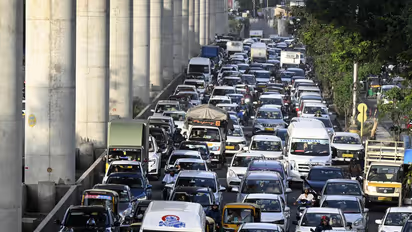
Bengaluru Development Minister Krishna Byre Gowda has directed officials to expedite the renovation and white-topping work on the Outer Ring Road (ORR), one of the city's key traffic corridors. The white-topping project is scheduled to begin in October and is targeted for completion by January. As the work is expected to affect traffic movement along the busy corridor, the minister has instructed officials to prepare a detailed traffic management plan and coordinate with companies operating along the ORR to minimise disruption for commuters.
To prevent severe traffic congestion during the construction period and ensure that the project progresses smoothly, the minister has asked officials to hold discussions with IT companies located along the ORR. The government plans to request these companies to allow around 50% of their employees to work from home (WFH) during the construction period. The move is aimed at reducing peak-hour traffic on the corridor while the white-topping work is underway.
3-Metre Footpaths And Encroachment Clearance
The minister has ordered the construction of continuous footpaths measuring at least 3 metres in width along the ORR. On slip roads, the footpaths will be 1.8 metres wide.
He has also directed officials to clear roadside encroachments immediately. Officials have been instructed to identify and remove transformers installed by private companies in public spaces.
On service roads where sufficient buffer space is available, designated pick-up and drop-off points for buses and taxis will be created. A colour-coding system will be introduced to make these locations easier to identify. Bus bays will also be constructed along the main road.
Alternate Routes For Traffic Management
To reduce congestion during the white-topping work, the minister has suggested making greater use of internal roads for traffic diversions. The traffic management plan will be finalised following discussions with the Outer Ring Road Companies Association (ORRCA) and the traffic police department.
The aim is to ensure that traffic continues to move smoothly while construction work is carried out on different stretches of the corridor.
₹450 Crore High-Tech Corridor Project
The project, estimated to cost around ₹450 crore, will also include 'Gig Hubs' for delivery personnel. These facilities are planned to provide shaded seating areas, mobile phone charging points, Wi-Fi and drinking water.
The project will also feature solar-powered charging docks for e-scooters and cycles, along with designated lay-bys for auto-rickshaws.
The 17-kilometre stretch between Silk Board and K.R. Puram is being developed as a 'Multimodal Mobility Corridor'. The project includes wider footpaths, cycle tracks, high-tech bus shelters, improved drainage infrastructure and upgrades to major junctions.
Public Wants Work To Start After Metro Launch
Several residents and commuters have urged the government to begin the white-topping work only after Metro services on the ORR become operational, citing concerns over traffic disruption.
During a recent review meeting with BMRCL officials, Minister Krishna Byre Gowda said trial runs on the ORR section of the Blue Line are expected to begin by October 2026. However, full-fledged commercial Metro services on the route are expected to be available to the public only in the following year.
The government is therefore working on traffic management measures, including discussions with IT and BT companies, alternative routes and pedestrian infrastructure, to minimise the impact of the white-topping project on Bengaluru's already busy roads.
Stay updated with the Breaking News Today and Latest News from across India and around the world. Get real-time updates, in-depth analysis, and comprehensive coverage of India News, World News, Indian Defence News, Kerala News, and Karnataka News. From politics to current affairs, follow every major story as it unfolds. Download the Asianet News Official App from the Android Play Store and iPhone App Store for accurate and timely news updates anytime, anywhere.