Is Punch the Monkey Going to Be Okay? Scientists Explain the Viral Macaque’s Future
Synopsis
Punch, a young Japanese macaque abandoned by his mother at Ichikawa Zoo, faces an uncertain future as he struggles for social acceptance within his group. Discover what experts say is crucial for his survival.
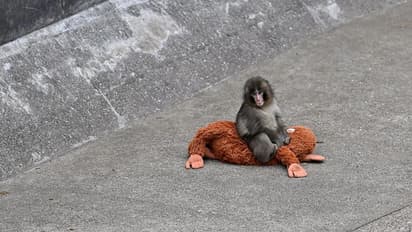
Scientists have shared insights about what could happen next for Punch, a young Japanese macaque who recently became a global sensation after videos showed him clinging to a soft toy for comfort. The seven-month-old monkey was born at Ichikawa Zoo in Japan, where he was abandoned by his mother shortly after birth and later had difficulty being accepted by the other monkeys in his group.
Experts suggest that Punch’s future will largely depend on whether he can form safe social connections with other macaques. Dr Emily Bethell, an associate professor in primate cognition and welfare at Liverpool John Moores University, explained to the Daily Mail that zoo staff are closely watching him and are trying different approaches to help him fit in with the group.
She mentioned that removing him from the group would only be considered if there was a serious risk to his safety, as macaques are extremely social and being isolated is seen as a final option.

Why Punch Needs to Live with Other Monkeys
Dr Bethell also pointed out that the bigger issue is not immediate harm but the long-term psychological impact of not being accepted socially. Young macaques typically rely a lot on their mothers during early life, learning essential social behaviours that help them understand group dynamics and interactions. Without these early experiences, Punch may find it more challenging to interact confidently with other monkeys in the future.
However, his gender might help improve his chances. Male Japanese macaques usually leave their birth group once they reach maturity, which means Punch might eventually be placed in a new group and build new social ties. This offers hope that he could still develop normally despite his difficult early years.
Many people have questioned why the zoo staff have not removed him from the enclosure. Dr Bethell warned that excessive human involvement could be harmful to his development. As she told the Daily Mail, it is crucial that Punch interacts with other macaques rather than relying primarily on humans, as this could prevent him from learning the necessary behaviours to function within a troop.
Why Did Punch’s Mother Abandon Him?
Experts have also discussed the reasons behind Punch’s initial abandonment. Professor Jo Setchell from Durham University explained that maternal rejection, though not common, is more likely to happen when a mother is young or inexperienced. Punch was reportedly his mother’s first infant, and new mothers can sometimes struggle with the demands of caring for a newborn. Extremely hot conditions at the time of his birth may have also increased stress, possibly leading the mother to prioritize her own survival.
Specialists say that while Punch appears endearing online, he remains a wild animal whose well-being depends on proper social development rather than human affection.