Buried Like a Man: 7,000-Year-Old Skeleton Reveals Surprising Gender Flexibility In Stone Age
Synopsis
Researchers studying ancient burial sites have revealed that Stone Age communities may have embraced far more complex identities and flexible gender roles than previously believed.
An archaeological discovery in Hungary is challenging long-held assumptions about gender roles in prehistoric societies. Researchers studying ancient burial sites have revealed that Stone Age communities may have embraced far more complex identities and flexible gender roles than previously believed.
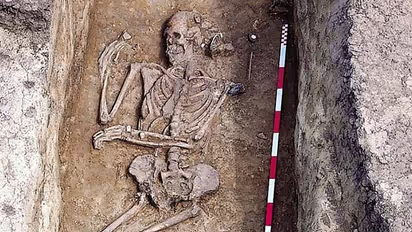
The breakthrough comes after scientists uncovered the 7,000-year-old skeleton of a woman buried in a manner typically reserved for men, suggesting that rigid gender norms may not have defined Neolithic societies.
A detailed study of 125 skeletons was found across several cemeteries in Hungary. Archaeologists observed that most individuals were buried according to a clear gender pattern. Men were usually laid to rest on their right side and accompanied by polished stone tools, while women were typically found lying on their left side and adorned with shell bead belts.
However, one burial in particular caught the researchers’ attention. The skeleton belonged to an older adult female, yet she had been interred with polished stone tools traditionally associated with male burials. Notably, she was the only female among the examined skeletons found with these objects.
Scientists discovered distinctive wear patterns on her toes, evidence of repeated kneeling activity commonly observed in men, possibly linked to work or ritual practices traditionally carried out by males.
A female buried with “traditionally masculine attributes,” suggests society “tolerated exceptions and was already experiencing the complexity of identities,” the researchers said.
The study was conducted by a team from the French National Centre for Scientific Research, who examined remains from two separate Neolithic cemeteries in Hungary.
At the first site, Polgar–Ferenci–hat, the team found no clear differences in how men and women were buried, indicating a relatively uniform burial practice.
In contrast, the second cemetery, Polgar–Csoszhalom, dating back to around 4800 BC, showed pronounced distinctions between male and female burials.
“The position of the body and the inclusion of grave goods appear to have been strongly influenced by the biological sex of the deceased,” the researchers wrote in the American Journal of Biological Anthropology.
Among all the skeletons buried with polished stone tools and displaying the typically masculine kneeling pattern, researchers identified nine men and just one woman, the exceptional burial that now intrigues archaeologists.
“The findings suggest that society at Csőszhalom was structured around gendered roles, yet allowed for individual variation,” the scientists wrote.
“Females may have assumed roles traditionally associated with males (and possibly vice versa), and some individuals were treated in death with funerary markers characteristic of both sexes.”
At the Csoszhalom site, scientists noted a high prevalence of spinal wear-and-tear, known as spondylosis, among both male and female skeletons.
In modern populations, such conditions are commonly seen in athletes engaged in physically demanding activities such as throwing sports, gymnastics, or rowing, suggesting that many individuals in the community likely performed intense physical labor.
“The majority of documented human societies manifest, to varying extents, normative expectations regarding the roles attributed to individuals on the basis of their biological sex,” the researchers wrote.
“This study enhances our understanding of prehistoric social organization by revealing both recurring sex-related patterns of behaviour and local flexibility in the expression of gender roles.”
History of Stone Age
The Stone Age is a period in human prehistory distinguished by the original development of stone tools that covers more than 95 per cent of human technological prehistory. It begins with the earliest known use of stone tools by hominins, ancient ancestors to humans, during the Old Stone Age - beginning around 3.3million years ago.
Also read: New Study Reveals How Corals Heal and Rebuild Themselves on the Reef